Acid Protease Applications: How to Use Acid Protease in Alcohol Production Formulations
Formulation guide for acid protease in alcohol production: pH, temperature, dosage, QC checks, pilot validation, and supplier qualification.
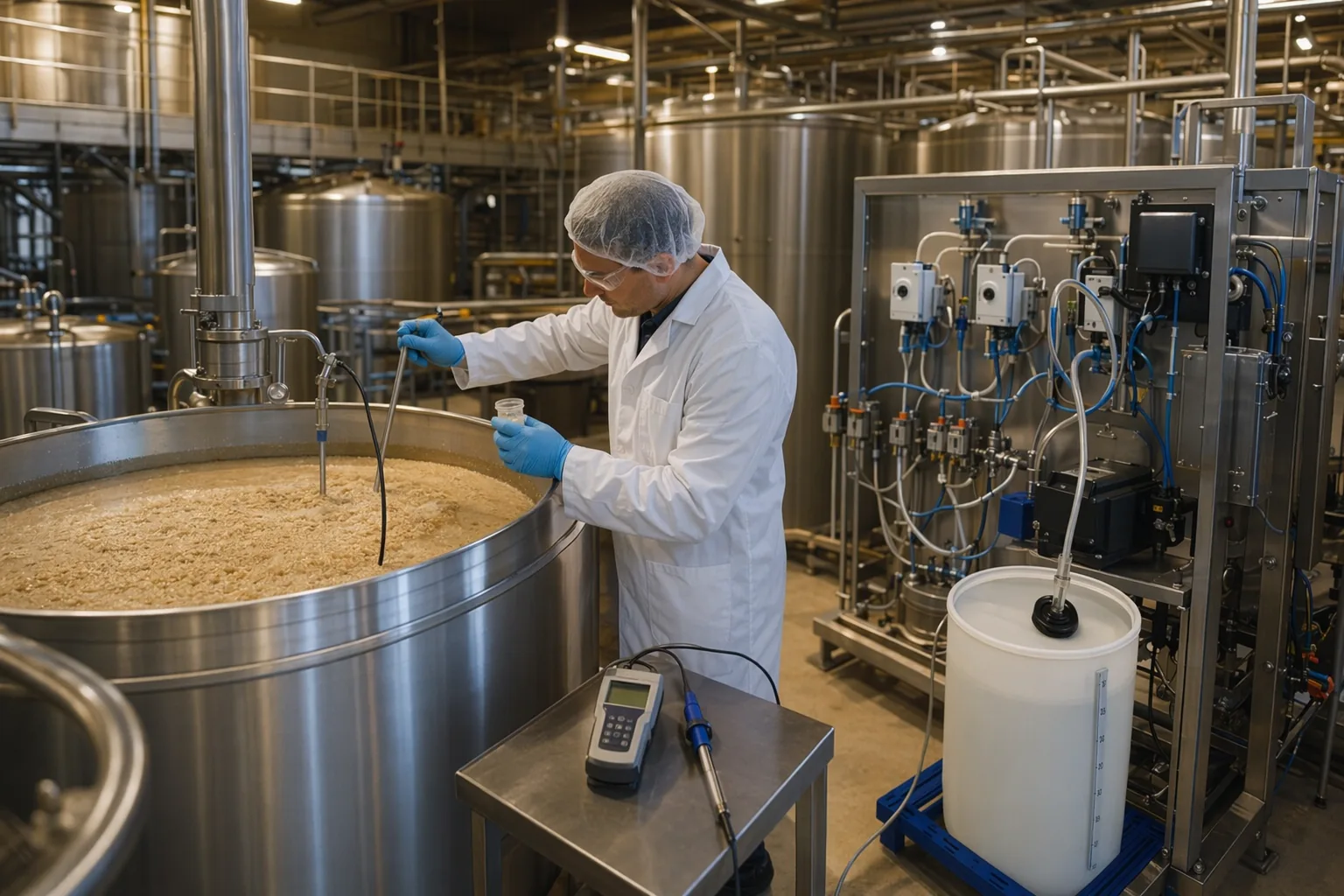
A practical B2B guide for distilleries, ethanol plants, and enzyme formulators evaluating acid protease for acidic mash, fermentation support, and protein hydrolysis.
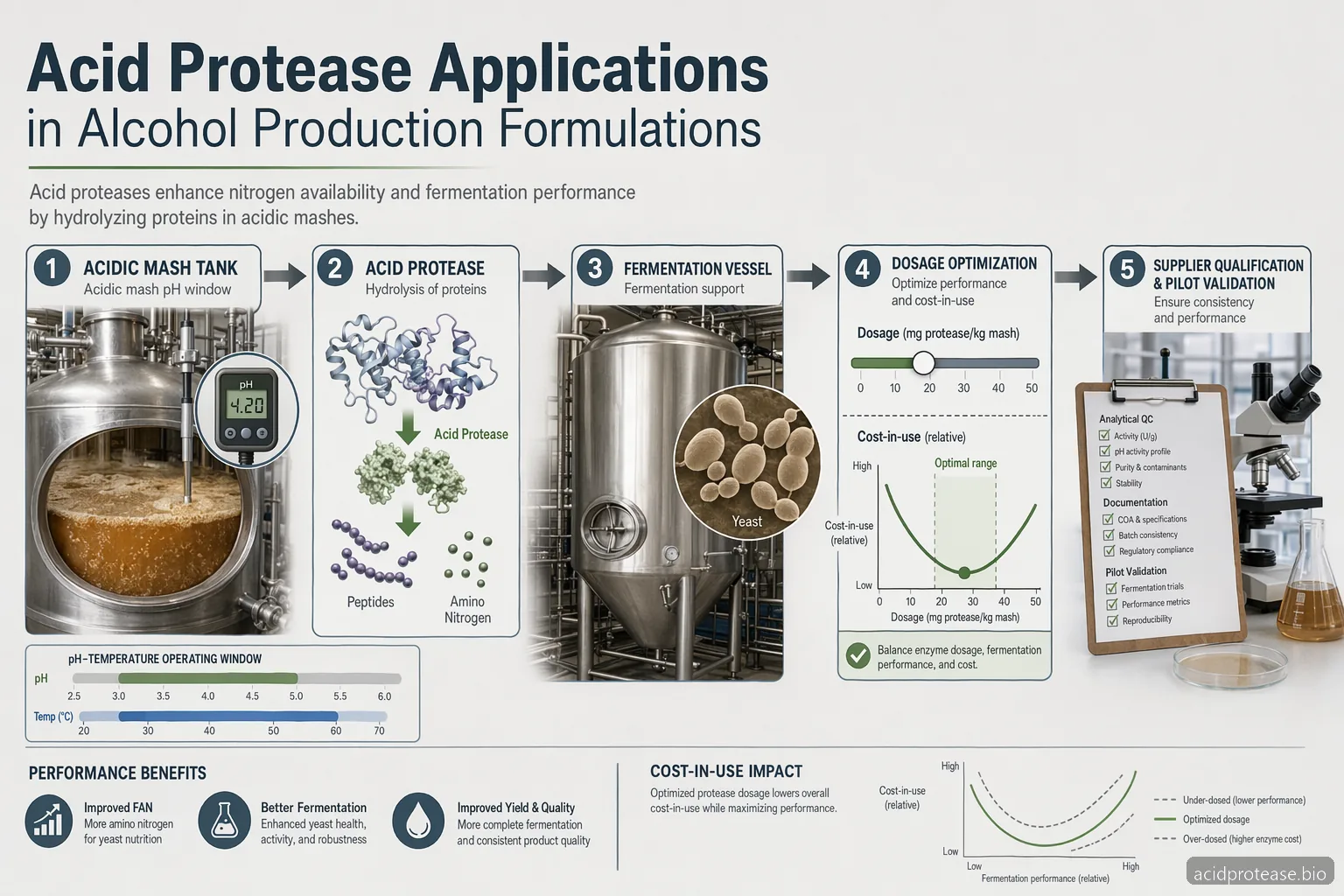
Where Acid Protease Fits in Alcohol Production
In alcohol production, acid protease is typically used where raw materials contain proteins that can limit processing efficiency or yeast nutrition. Grain, cassava blends, molasses streams, and other carbohydrate feedstocks may carry protein fractions that benefit from controlled hydrolysis under acidic conditions. The enzyme breaks peptide bonds to generate smaller peptides and amino acids, which can contribute to free amino nitrogen and reduce the burden on downstream fermentation. For plants already using liquefaction and saccharification enzymes, acid protease is usually evaluated as an auxiliary enzyme rather than a standalone conversion aid. It is most relevant when mash pH is acidic, when fermentation nutrition is variable, or when protein residues affect solids handling. The best acid protease applications are selected by measuring process response: FAN release, fermentation kinetics, ethanol yield trend, residual protein, viscosity, and cost per liter of alcohol.
Common use points include mash conditioning, pre-fermentation holding, and early fermentation. • Best fit is usually acidic feedstocks or processes already operating below neutral pH. • Evaluate against measurable plant KPIs, not only enzyme activity on paper.
Mechanism and Enzyme Type: Aspartic Acid Protease
Many commercial fungal acid protease products are classified as aspartic acid protease enzymes. The aspartic acid protease mechanism uses catalytic aspartate residues to activate water for peptide bond cleavage, with strongest performance typically in acidic pH ranges. This makes the enzyme different from neutral or alkaline proteases that may lose performance in low-pH mash. Buyers sometimes ask about protease amino acid data, but industrial selection normally depends more on activity profile, substrate range, stability, and application testing than on a published sequence. For example, a TEV protease amino acid sequence is useful in molecular biology, but it is not a practical benchmark for bulk alcohol production formulations. For industrial procurement, the supplier should define activity units, assay pH, temperature, production organism type, carrier system, and whether the product is liquid or powder.
Target enzyme class: acid-active protease, often fungal aspartic acid protease. • Key selection factors: pH profile, thermal stability, activity units, and process compatibility. • Sequence information is less important than validated performance in the buyer’s feedstock.
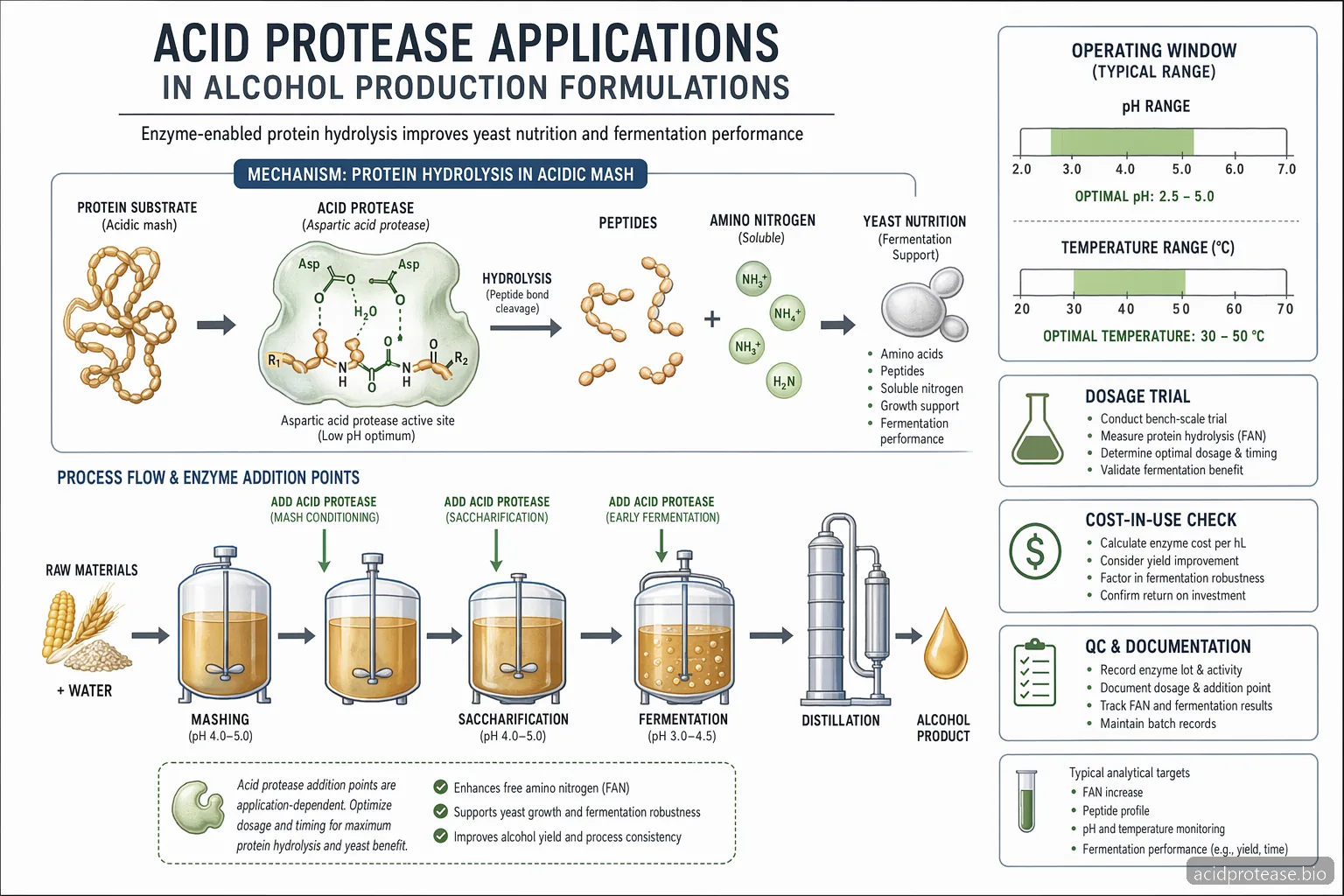
Formulation Conditions: pH, Temperature, and Addition Point
A practical starting window for acid protease enzyme evaluation is pH 3.0-5.5, with many products performing well around pH 3.5-5.0. Temperature tolerance varies by supplier and formulation, but pilot trials commonly screen 35-60°C, matching mash holding, cooling, or early fermentation conditions. If the process includes high-temperature cooking, acid protease is usually added after cooling unless the supplier confirms adequate heat stability. For fermentation-facing use, the enzyme must be compatible with yeast, nutrients, antimicrobial strategy, and other enzymes such as glucoamylase. An acid stable protease may retain activity during extended acidic holding, but buyers should confirm half-life data from the TDS. Formulators should avoid assuming one universal condition set; feedstock particle size, solids level, pH drift, and residence time all influence hydrolysis.
Initial pH screen: 3.0, 3.5, 4.0, 4.5, and 5.0. • Initial temperature screen: 35°C, 45°C, 55°C, and process-relevant hold temperature. • Confirm compatibility with glucoamylase, yeast nutrition, and sanitation chemistry. • Add after severe heat steps unless the TDS supports hot-side dosing.
Dosage Strategy and Cost-in-Use Optimization
Dosage should be developed from enzyme activity units, substrate protein level, residence time, and measurable plant benefit. As a broad screening range, many formulation teams begin with 10-100 g of commercial product per metric ton of dry feedstock for concentrated powders, or 50-300 ppm for liquid products, then adjust based on the supplier’s activity and formulation strength. These are only trial bands, not universal recommendations. The correct dose is the lowest level that delivers a repeatable improvement in FAN, fermentation rate, residual protein, viscosity, alcohol yield, or solids separation. Cost-in-use should include enzyme price, dose, handling cost, storage loss, process time, and any effect on downstream quality. A cheaper acid protease may be more expensive if it requires higher dosage or produces inconsistent results across raw material lots.
Run dose-response trials at low, medium, and high inclusion rates. • Calculate cost per metric ton of feedstock and cost per liter of alcohol produced. • Track both process benefit and variability across raw material lots. • Do not compare products by price per kilogram without normalizing activity and dose.
QC Checks, Documentation, and Supplier Qualification
For B2B procurement, a qualified acid protease supplier should provide a current COA, TDS, and SDS for each commercial product. The COA should list activity, batch number, manufacturing date or retest date, appearance, moisture or solids where relevant, and agreed microbiological specifications. The TDS should define activity assay conditions, recommended pH and temperature ranges, storage, shelf life, solubility or dispersion instructions, and application notes. The SDS should cover safe handling, dust or aerosol precautions, PPE, transport information, and spill response. Before plant approval, request a representative sample, retain sample policy, change-notification practice, and lot-to-lot consistency data. Supplier qualification should also review production capacity, packaging options, lead time, technical support, and willingness to support pilot validation without making unsupported performance guarantees.
Request COA, TDS, SDS, activity assay method, and storage guidance. • Confirm packaging compatibility with plant dosing and inventory systems. • Use pilot validation before long-term supply approval. • Agree on notification requirements for formulation or manufacturing changes.
Pilot Validation Plan for Alcohol Plants
A robust pilot plan compares the proposed protease acid formulation against a no-protease control under the same feedstock, solids, pH, temperature, yeast, and fermentation time. Start with bench-scale hydrolysis and fermentation trials, then move to a production-side trial only after the data show a clear operating window. Key measurements include soluble nitrogen, FAN, degree of hydrolysis, fermentation rate, final alcohol concentration, residual sugars, residual protein, viscosity, centrifuge or filtration behavior, and sensory or impurity indicators where relevant to beverage alcohol. For fuel ethanol, focus on yield trend, fermentation completion, byproduct profile, and process stability. Record exact addition point, dilution water, mixing time, and hold time. The goal is not to prove a generic claim about acid protease applications, but to define a reproducible plant-specific formulation.
Use a no-enzyme control and at least three dosage levels. • Keep pH, temperature, feedstock lot, yeast, and residence time consistent. • Scale up only after repeatable bench or pilot data. • Document both technical performance and cost-in-use.
Technical Buying Checklist
Buyer Questions
An acid stable protease is a protease that retains useful activity under low-pH process conditions, typically in the acidic range used for mash conditioning or fermentation. In alcohol production, it helps hydrolyze feedstock proteins into peptides and amino acids. Stability must be confirmed from the supplier TDS and plant trials because pH, temperature, residence time, and feedstock composition strongly affect real performance.
Choose an acid protease supplier based on documented activity, application fit, lot consistency, and technical support. Request COA, TDS, SDS, assay method, storage guidance, sample availability, and pilot trial support. Review packaging, lead time, change-notification practice, and cost-in-use. Avoid selecting only by price per kilogram because different products can vary widely in activity concentration and process stability.
It can be evaluated in early fermentation if the product is compatible with yeast, pH, temperature, nutrients, and other enzymes. However, direct addition should be validated carefully because alcohol concentration, acidity, and residence time can reduce enzyme activity. Many plants compare pre-fermentation mash conditioning with early fermentation dosing to determine which point gives better FAN release, fermentation kinetics, and cost-in-use.
The aspartic acid protease mechanism explains why many fungal acid proteases work well at low pH: catalytic aspartate residues support peptide bond hydrolysis in acidic conditions. For industrial buyers, the mechanism is useful background, but purchase decisions should focus on activity profile, stability, dosage, safety documents, process compatibility, and pilot performance in the actual alcohol production formulation.
Usually not for standard industrial alcohol applications. A protease amino acid sequence, such as a TEV protease amino acid sequence used in research contexts, is not normally required to qualify a bulk acid protease. Buyers should instead request product specifications, activity assay conditions, safety documentation, origin information allowed by the supplier, and pilot data showing consistent performance in the target feedstock.
Acid Protease for Research & Industry
Need Acid Protease for your lab or production process?
ISO 9001 certified · Food-grade & research-grade · Ships to 80+ countries
Frequently Asked Questions
What is acid stable protease in alcohol production?
An acid stable protease is a protease that retains useful activity under low-pH process conditions, typically in the acidic range used for mash conditioning or fermentation. In alcohol production, it helps hydrolyze feedstock proteins into peptides and amino acids. Stability must be confirmed from the supplier TDS and plant trials because pH, temperature, residence time, and feedstock composition strongly affect real performance.
How do I choose an acid protease supplier?
Choose an acid protease supplier based on documented activity, application fit, lot consistency, and technical support. Request COA, TDS, SDS, assay method, storage guidance, sample availability, and pilot trial support. Review packaging, lead time, change-notification practice, and cost-in-use. Avoid selecting only by price per kilogram because different products can vary widely in activity concentration and process stability.
Can acid protease be added directly to fermentation?
It can be evaluated in early fermentation if the product is compatible with yeast, pH, temperature, nutrients, and other enzymes. However, direct addition should be validated carefully because alcohol concentration, acidity, and residence time can reduce enzyme activity. Many plants compare pre-fermentation mash conditioning with early fermentation dosing to determine which point gives better FAN release, fermentation kinetics, and cost-in-use.
Is aspartic acid protease mechanism important for buyers?
The aspartic acid protease mechanism explains why many fungal acid proteases work well at low pH: catalytic aspartate residues support peptide bond hydrolysis in acidic conditions. For industrial buyers, the mechanism is useful background, but purchase decisions should focus on activity profile, stability, dosage, safety documents, process compatibility, and pilot performance in the actual alcohol production formulation.
Do I need the protease amino acid sequence for procurement?
Usually not for standard industrial alcohol applications. A protease amino acid sequence, such as a TEV protease amino acid sequence used in research contexts, is not normally required to qualify a bulk acid protease. Buyers should instead request product specifications, activity assay conditions, safety documentation, origin information allowed by the supplier, and pilot data showing consistent performance in the target feedstock.
Related: Acid Protease for Acidic Processing Lines
Turn This Guide Into a Supplier Brief Request acid protease samples, TDS, SDS, and pilot trial support for your alcohol production formulation. See our application page for Acid Protease for Acidic Processing Lines at /applications/acid-protease-acidic-processing/ for specs, MOQ, and a free 50 g sample.
Contact Us to Contributehello@mail.acidprotease.bio