Acid Protease Feed Additive Market: Process Guide
B2B guide to acid protease for animal feed: pH, temperature, dosage, QC, pilot validation, cost-in-use, and supplier qualification.
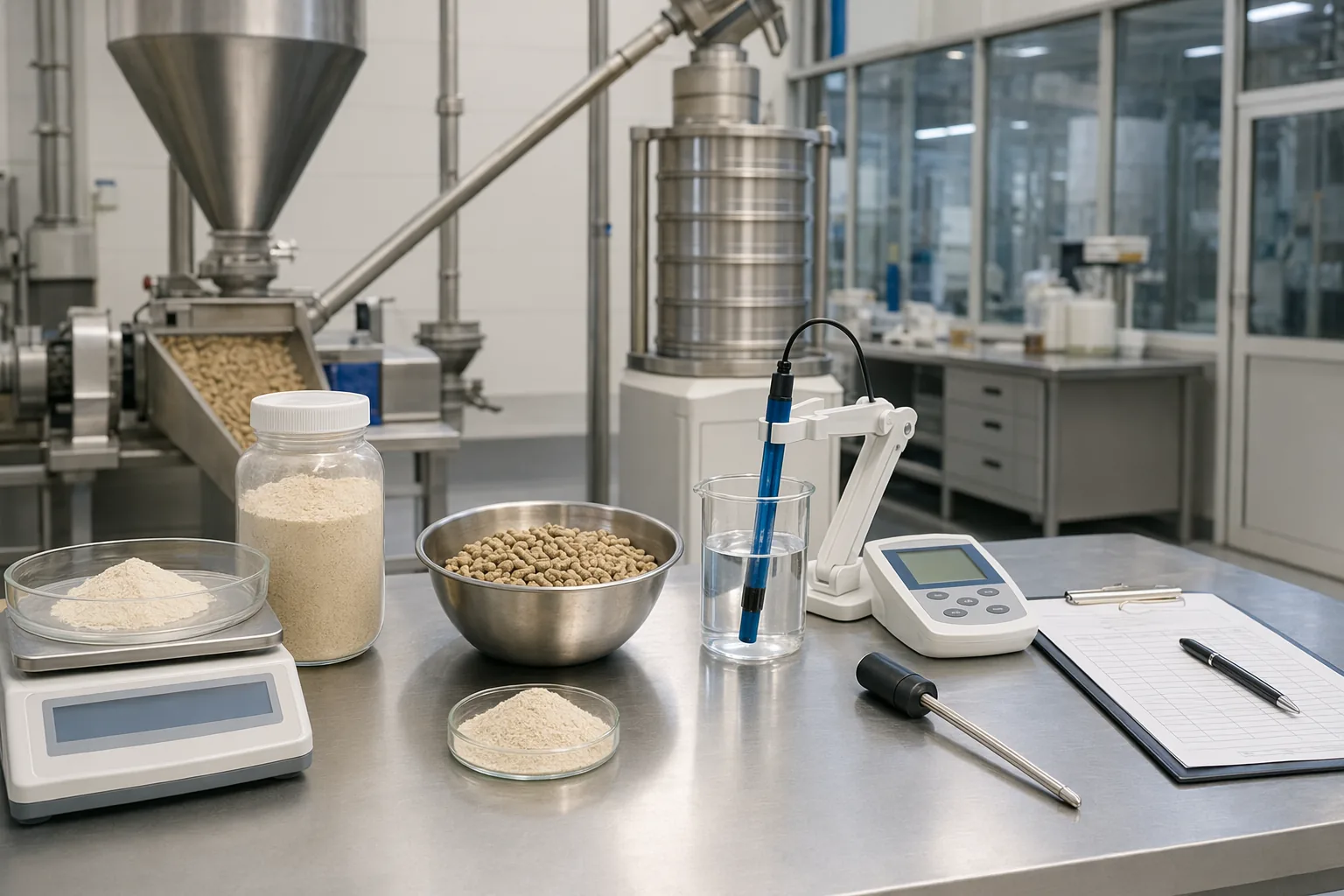
A practical sourcing and application guide for feed manufacturers evaluating acid protease enzyme performance, stability, and cost-in-use.
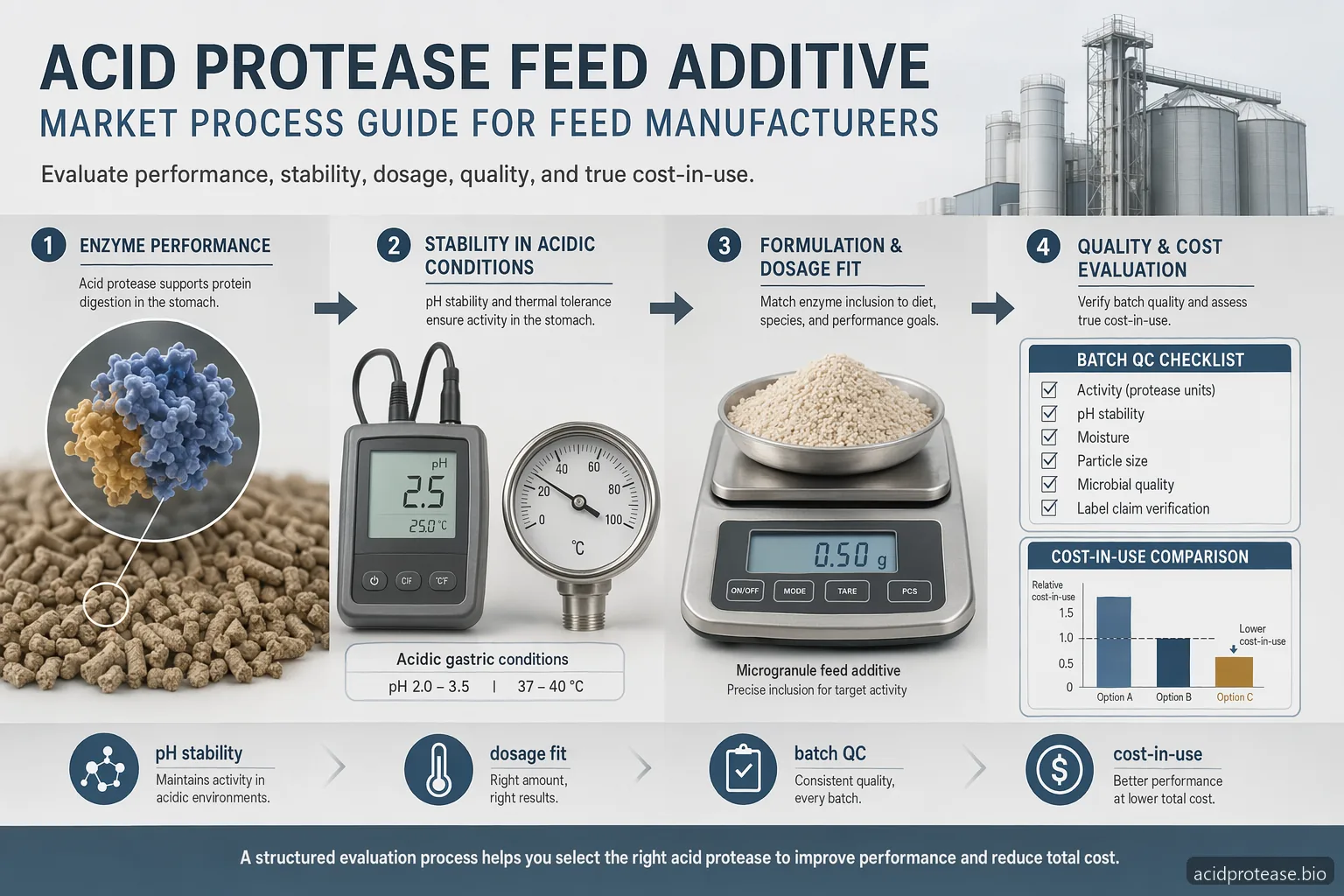
Why the Acid Protease Feed Additive Market Matters
The acid protease feed additive market is driven by feed mills and integrators seeking more efficient use of soybean meal, fish meal, animal by-products, and other protein sources. In animal feed, acid protease enzyme activity is most relevant where the digestive environment is acidic and dietary proteins require further hydrolysis into smaller peptides. For B2B buyers, the key question is not whether an acid protease for animal feed is available, but whether the product fits the diet, process, and commercial target. A fungal acid protease may offer useful acidic pH activity, while formulation and coating can influence stability during storage or pelleting. The strongest purchasing programs define the target species, feed form, protein matrix, and expected inclusion point before asking suppliers for quotations. This makes it easier to compare an industrial acid protease supplier animal feed proposal against real production conditions.
Relevant for compound feed, premix, concentrate, and specialty nutrition manufacturers. • Common evaluation areas include protein digestibility support, formulation flexibility, and retained enzyme activity. • Best suited to buyers with defined feed matrices and measurable performance targets.
Application Conditions for Acid Protease in Animal Feed
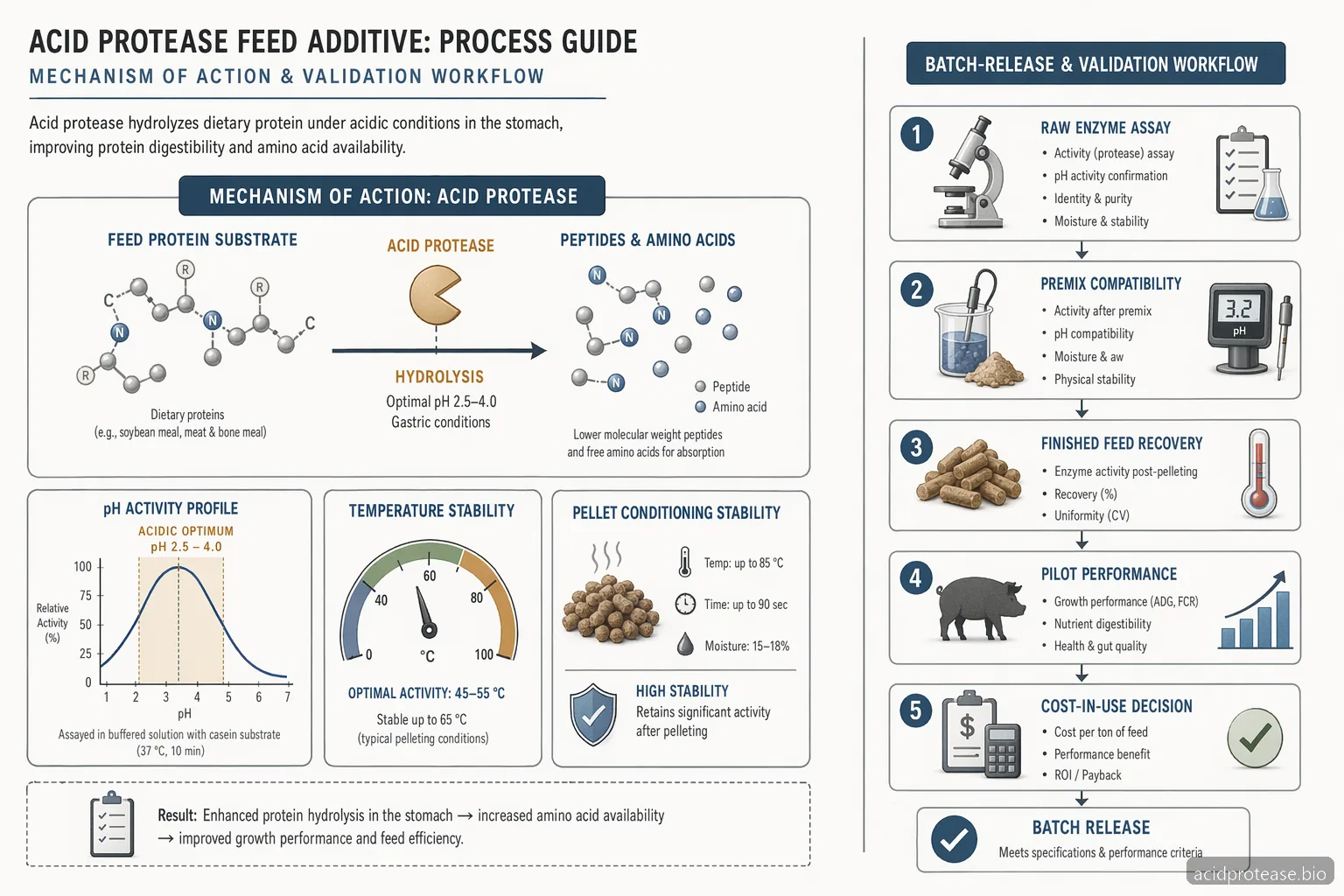
An industrial acid protease enzyme animal feed program should start with conditions that reflect the target digestive and manufacturing environment. Many acid proteases are designed for activity in acidic ranges, commonly around pH 2.5-5.5, although the optimal range depends on strain, fermentation process, and formulation. Temperature evaluation should distinguish between activity temperature and process tolerance. Enzyme assays may be run near 37-55°C, while feed production can expose the additive to short-term pelleting temperatures of 75-90°C or higher depending on conditioner settings. Buyers should confirm whether the enzyme is added before pelleting, after pelleting, or through a liquid post-pellet system. Moisture, residence time, steam quality, and premix dilution can all affect retained activity. For practical validation, test the exact feed formulation, not only a laboratory substrate, because minerals, acids, binders, and processing aids may influence enzyme performance.
Typical pH screening: 2.5-5.5, confirmed by supplier method. • Evaluate pelleting exposure by temperature, moisture, and residence time. • Check compatibility with premix carriers, acids, minerals, and binders. • Confirm whether dry or liquid application is preferred.
Dosage Strategy and Formulation Fit
Dosage should be expressed in declared activity units per kilogram or metric ton of finished feed, not only as grams of product. A typical screening band may begin with 5,000-50,000 activity units per kilogram of finished feed, but the correct range depends on the supplier assay, enzyme concentration, species, age phase, and protein ingredients. Some programs evaluate a low, medium, and high dose during pilot trials to define the response curve and avoid over-formulation. When comparing acid protease enzyme supplier for animal feed options, request the recommended inclusion rate, activity definition, analytical method, and expected retained activity after processing. The enzyme should also fit the feed manufacturer’s weighing, dosing, and mixing capability. Fine powders may disperse differently than granulated products, while liquids require pump accuracy and microbial control. A practical formulation review should include homogeneity, segregation risk, dust control, and storage stability.
Compare products by delivered activity in finished feed. • Run dose-response trials before full commercial conversion. • Confirm mixing uniformity and enzyme recovery in representative batches. • Assess dusting, flowability, liquid pumpability, and storage stability.
QC Checks, Documentation, and Batch Release
For industrial acid protease animal feed purchasing, documentation is part of the product. Each shipment should be supported by a certificate of analysis showing batch number, declared activity, manufacturing or retest date, and key quality parameters defined by the supplier. The technical data sheet should describe appearance, activity method, recommended pH and temperature range, dosage guidance, storage conditions, packaging, and handling limits. The safety data sheet should address occupational handling, dust exposure, spill response, and personal protective equipment. Feed manufacturers may also request microbiological limits, heavy metal guidance where applicable, and allergen or carrier statements when relevant to their internal risk assessment. Incoming QC can include appearance, odor, packaging integrity, moisture if specified, and retained activity testing using the agreed method. Because protease assays vary, buyers should avoid comparing activity numbers from different methods without conversion or technical explanation.
Request COA, TDS, and SDS before pilot purchase. • Confirm assay method and unit definition. • Inspect packaging integrity and storage conditions on receipt. • Use retained activity testing after pelleting or storage.
Pilot Validation and Cost-in-Use Analysis
The best acid protease supplier for animal feed should support a structured pilot rather than only provide a quotation. A typical pilot includes baseline feed, one or more enzyme dosages, representative processing conditions, and a plan for retained activity testing. Depending on the buyer’s objectives, performance indicators may include in vitro protein hydrolysis, feed conversion observations, nitrogen utilization indicators, pellet quality, or compatibility with existing enzyme blends. Cost-in-use should be calculated as delivered enzyme cost per metric ton of finished feed at the validated dose, adjusted for activity retention, handling losses, and any operational changes. A lower unit price may not be economical if the product requires higher dosage or loses more activity during conditioning. Supplier qualification should also consider lead time, batch consistency, technical responsiveness, packaging formats, minimum order quantity, and the ability to provide repeatable documentation for every lot.
Define success criteria before purchasing trial volume. • Calculate cost per ton of finished feed, not only product price. • Include retained activity and handling losses in cost-in-use. • Qualify suppliers on quality consistency and technical support.
Technical Buying Checklist
Buyer Questions
Ask for the COA, TDS, SDS, activity unit definition, assay method, recommended dosage, pH and temperature profile, storage conditions, packaging options, and available pilot guidance. For industrial purchasing, also request batch traceability, shelf-life or retest policy, minimum order quantity, lead time, and technical support scope. These details allow buyers to compare products by delivered activity and process fit rather than label claims alone.
Many acid proteases are evaluated in acidic conditions, often around pH 2.5-5.5, because this range is relevant to gastric protein hydrolysis. The exact optimum can vary by enzyme source and formulation, so the supplier’s assay method should be reviewed. Buyers should also test representative feed matrices, since ingredients, minerals, organic acids, and buffers can change the effective environment around the enzyme.
Survival depends on formulation, conditioning temperature, steam quality, moisture, residence time, and whether the enzyme is powder, granule, coated, or liquid. Pelleting may expose feed to 75-90°C or higher for short periods, so retained activity should be measured after the real process. If losses are high, buyers can evaluate coated grades, lower-temperature processing, or post-pellet liquid application.
Compare dosage by activity units delivered per kilogram or metric ton of finished feed, not by kilograms of product alone. Different suppliers may use different assay methods and unit definitions, so activity numbers are not always directly interchangeable. A practical comparison includes recommended dose, retained activity after processing, mixing uniformity, feed matrix response, packaging losses, and total cost-in-use at the validated inclusion level.
A reliable supplier provides consistent batch documentation, clear technical data, responsive application support, stable packaging, realistic lead times, and transparent assay methods. They should be willing to support pilot validation using the buyer’s feed conditions instead of relying only on generic data. Supplier qualification should also review traceability, lot-to-lot consistency, storage guidance, complaint handling, and the ability to provide COA, TDS, and SDS for each order.
Related Search Themes
industrial acid protease supplier animal feed, industrial acid protease enzyme animal feed, industrial acid protease animal feed, acid protease supplier supplier for animal feed, acid protease supplier for animal feed, acid protease for animal feed
Acid Protease for Research & Industry
Need Acid Protease for your lab or production process?
ISO 9001 certified · Food-grade & research-grade · Ships to 80+ countries
Frequently Asked Questions
What should buyers ask an acid protease enzyme supplier for animal feed?
Ask for the COA, TDS, SDS, activity unit definition, assay method, recommended dosage, pH and temperature profile, storage conditions, packaging options, and available pilot guidance. For industrial purchasing, also request batch traceability, shelf-life or retest policy, minimum order quantity, lead time, and technical support scope. These details allow buyers to compare products by delivered activity and process fit rather than label claims alone.
What pH range is relevant for acid protease for animal feed?
Many acid proteases are evaluated in acidic conditions, often around pH 2.5-5.5, because this range is relevant to gastric protein hydrolysis. The exact optimum can vary by enzyme source and formulation, so the supplier’s assay method should be reviewed. Buyers should also test representative feed matrices, since ingredients, minerals, organic acids, and buffers can change the effective environment around the enzyme.
Can acid protease survive feed pelleting?
Survival depends on formulation, conditioning temperature, steam quality, moisture, residence time, and whether the enzyme is powder, granule, coated, or liquid. Pelleting may expose feed to 75-90°C or higher for short periods, so retained activity should be measured after the real process. If losses are high, buyers can evaluate coated grades, lower-temperature processing, or post-pellet liquid application.
How should dosage be compared between suppliers?
Compare dosage by activity units delivered per kilogram or metric ton of finished feed, not by kilograms of product alone. Different suppliers may use different assay methods and unit definitions, so activity numbers are not always directly interchangeable. A practical comparison includes recommended dose, retained activity after processing, mixing uniformity, feed matrix response, packaging losses, and total cost-in-use at the validated inclusion level.
What makes a reliable industrial acid protease supplier for animal feed?
A reliable supplier provides consistent batch documentation, clear technical data, responsive application support, stable packaging, realistic lead times, and transparent assay methods. They should be willing to support pilot validation using the buyer’s feed conditions instead of relying only on generic data. Supplier qualification should also review traceability, lot-to-lot consistency, storage guidance, complaint handling, and the ability to provide COA, TDS, and SDS for each order.
Related: Acid Protease for Acidic Processing Lines
Turn This Guide Into a Supplier Brief Request acid protease feed additive specifications, samples, and pilot support for your target feed formulation. See our application page for Acid Protease for Acidic Processing Lines at /applications/acid-protease-acidic-processing/ for specs, MOQ, and a free 50 g sample.
Contact Us to Contributehello@mail.acidprotease.bio