Acid Protease Production: Supplier Guide for Alcohol Production
Buyer guide to acid protease production, supplier qualification, dosing, QC, and pilot validation for alcohol production.
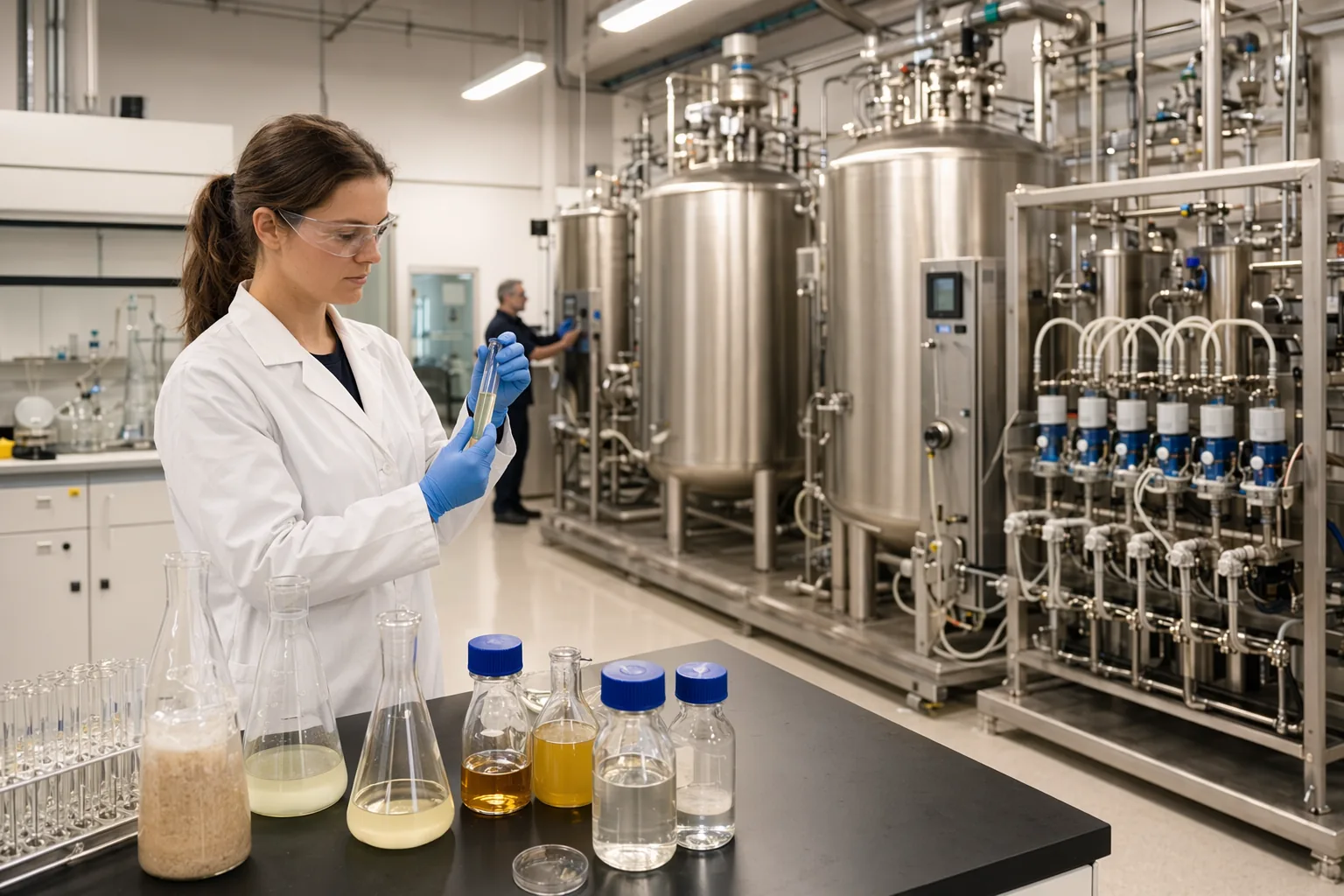
Select an acid protease enzyme for alcohol production with practical guidance on process fit, QC documents, pilot trials, and cost-in-use.
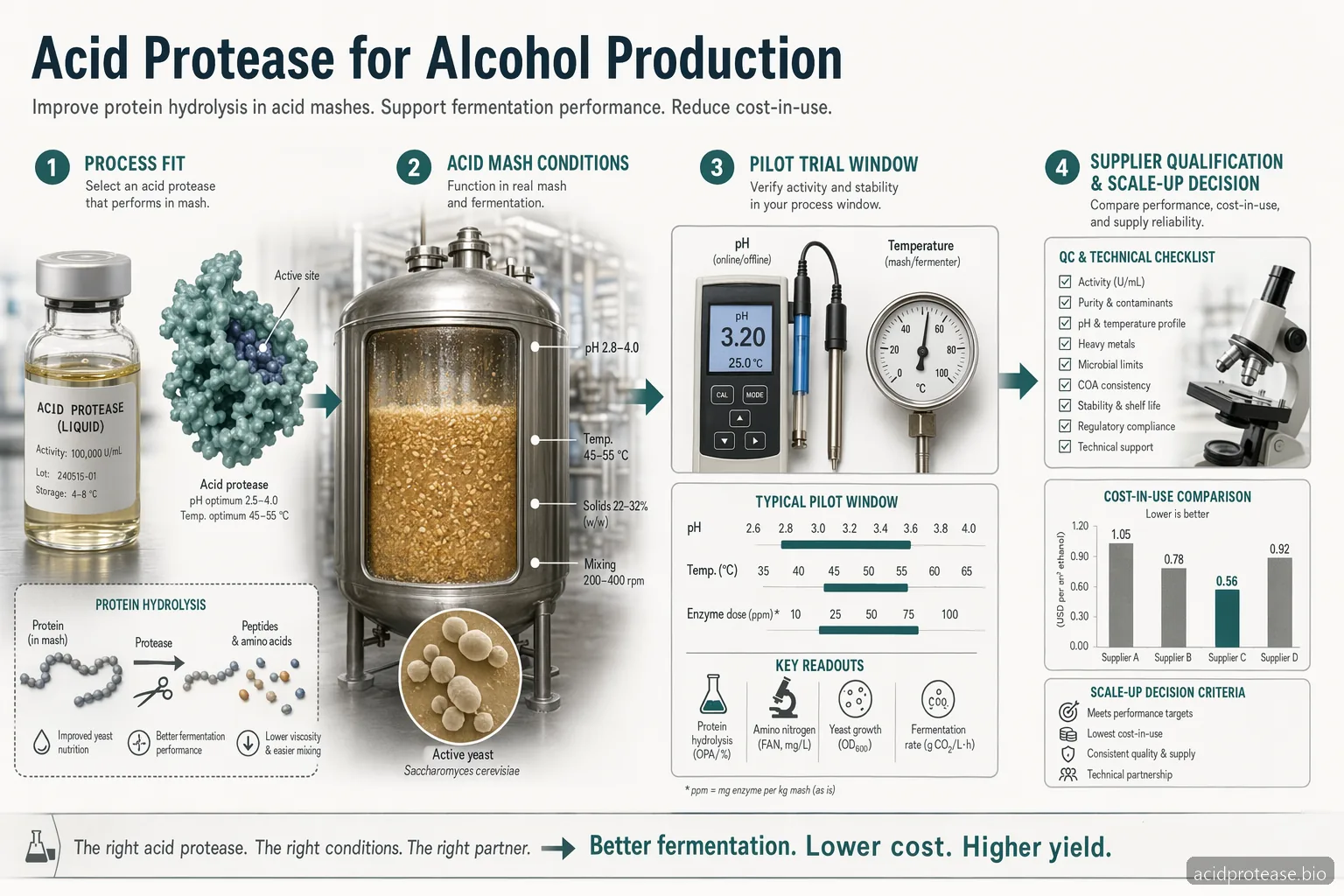
Why Acid Protease Matters in Alcohol Production
In alcohol production, acid protease is used to hydrolyze proteins and peptides in grain, tuber, or other carbohydrate-rich substrates under acidic process conditions. The goal is usually not to replace amylases, but to complement starch conversion by improving nitrogen availability, reducing protein-related viscosity issues, and supporting more consistent fermentation performance. For buyers searching for acid protease production or an industrial acid protease enzyme alcohol production solution, the key question is whether the enzyme performs in the plant’s actual mash, pH, temperature, residence time, and raw material matrix. Many commercial acid protease products are fungal acid protease preparations, often selected for activity in acidic ranges. However, enzyme origin alone is not enough for procurement. Alcohol producers should review the technical data sheet, certificate of analysis, safety data sheet, recommended dose range, and available application data before moving to plant trials.
Best suited to acidic liquefaction, saccharification, or mash-conditioning steps. • Used alongside amylases, glucoamylases, and other process enzymes. • Performance depends on substrate protein profile and process residence time.
Production Route and Enzyme Selection Criteria
Commercial acid protease production commonly uses controlled microbial fermentation, followed by recovery, clarification, concentration, and formulation into liquid or powder products. Literature may discuss process kinetics of acid protease production by Aspergillus niger, acid protease production by isolated species of Penicillium, and acid protease production in fungal root endophytes. These topics are useful for R&D context, but industrial buyers should focus on reproducible manufacturing, lot-to-lot consistency, application activity, and supply reliability. A supplier should be able to explain the declared activity method, formulation stability, storage recommendations, and any relevant allergens or handling precautions. Ask whether the product is intended for industrial processing and whether it has been evaluated in alcohol production conditions similar to your plant. Avoid selecting only by headline activity units, because different assay methods, pH values, and substrates can make unit comparisons misleading.
Confirm assay method and activity definition. • Request recent COA, TDS, and SDS before testing. • Check shelf-life, storage temperature, and packaging options. • Ask for application data in alcohol production, not only generic protease data.
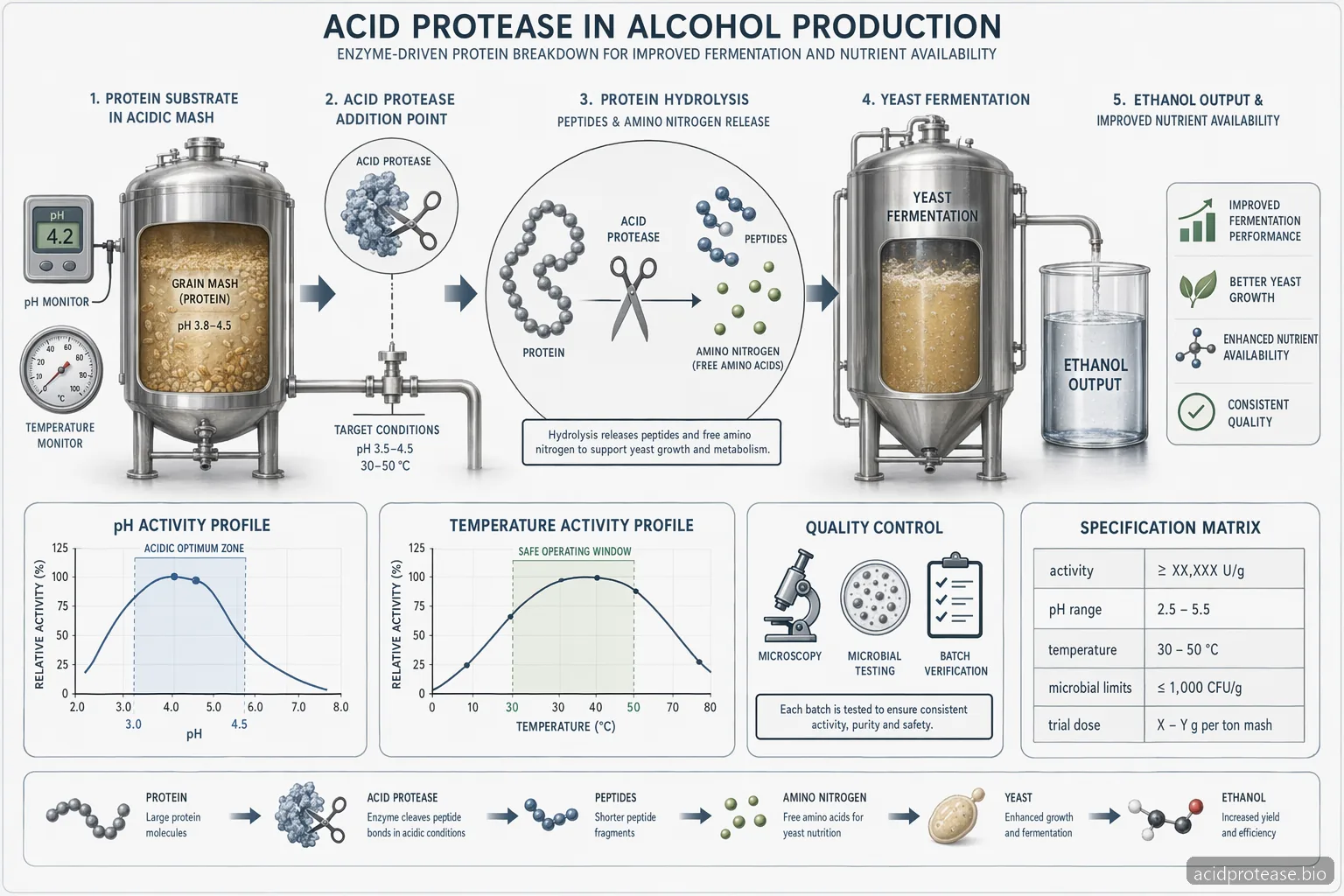
Practical Process Conditions for Pilot Trials
A well-designed pilot trial should test the acid protease enzyme under realistic plant conditions. Many acid protease products show useful activity around pH 2.5 to 5.5, with common alcohol-process evaluations near pH 3.5 to 5.0 depending on raw material and process step. Temperature screening often covers 35 to 60°C, although exact optimum and stability depend on the product formulation. Initial dosage trials may begin around 50 to 500 g per metric ton of dry substrate for liquid products, or an equivalent activity-based dose for powders, then adjust according to hydrolysis response and economics. Measure soluble nitrogen, FAN where relevant, peptide release, viscosity, fermentation rate, ethanol yield, residual sugars, and any downstream clarification impact. Industrial acid protease alcohol production trials should include an untreated control and, where possible, a current enzyme program benchmark.
Run at least three dose levels plus a control. • Track pH and temperature throughout the enzyme contact period. • Evaluate both process benefit and downstream compatibility. • Repeat promising conditions with a second raw material lot.
Supplier Qualification for B2B Procurement
When evaluating an acid protease supplier for alcohol production, procurement teams should combine technical validation with commercial and quality checks. A qualified industrial acid protease supplier alcohol production partner should provide batch-specific COA, current TDS, SDS, recommended handling procedures, and clear storage guidance. Ask about manufacturing consistency, change notification practices, sample availability, minimum order quantities, lead times, and packaging formats suited to your dosing system. If searching phrases such as acid protease supplier for alcohol production or acid protease supplier supplier for alcohol production, prioritize suppliers that can discuss plant constraints rather than only quoting price per kilogram. Request support for pilot protocol design, dosage optimization, and troubleshooting if foam, viscosity, fermentation lag, or filterability changes occur. For multi-site operations, verify whether the supplier can support consistent supply and documentation across all plants.
Require COA, TDS, SDS, and batch traceability. • Confirm technical support for pilot and scale-up. • Review lead time, packaging, and storage fit. • Ask about notification for formulation or manufacturing changes.
Cost-in-Use and Scale-Up Decision Making
The lowest purchase price is not always the lowest operating cost. Cost-in-use should include enzyme dose, activity retention during storage, ease of handling, dosing accuracy, impact on fermentation time, ethanol yield, nutrient supplementation, energy use, cleaning, and downstream separation. A plant may prefer a higher-priced acid protease if it achieves the same hydrolysis at a lower dose or reduces variability in fermentation. During scale-up, keep the same substrate basis used in the pilot, document contact time, pH adjustment, enzyme addition point, and mixing intensity. Compare each trial against production KPIs such as alcohol yield, cycle time, residual protein behavior, yeast performance, and coproduct quality where applicable. Before committing to annual supply, run a representative plant trial, confirm documentation review with quality and EHS teams, and agree on commercial terms that support reliable production.
Compare cost per ton of substrate, not only cost per kilogram. • Include labor, storage, dilution, and dosing system impacts. • Use plant KPIs to justify adoption. • Lock specifications only after pilot validation.
Technical Buying Checklist
Buyer Questions
Acid protease is used to hydrolyze proteins in acidic mash or related process steps. In alcohol production, this can increase soluble nitrogen and peptides, improve mash handling in some substrates, and support more consistent fermentation conditions. It is typically used with amylases and glucoamylases, not as a replacement. Actual value depends on raw material protein content, process pH, temperature, residence time, and dosage.
Choose an acid protease supplier based on application fit, documentation, consistency, and support. Request a current TDS, batch COA, SDS, activity method, storage recommendations, and pilot trial guidance. Ask for data relevant to alcohol production and confirm lead time, packaging, minimum order quantities, and batch traceability. A strong supplier should help optimize dose and evaluate cost-in-use rather than only quote enzyme price.
Many industrial acid protease products are screened around pH 3.5 to 5.0 for alcohol applications, with broader activity sometimes extending from about pH 2.5 to 5.5. Temperature trials often start between 35 and 60°C. Use the supplier’s TDS as the primary reference, then test under real plant conditions because substrate composition, salts, residence time, and mixing can change performance.
A practical starting range is often 50 to 500 g per metric ton of dry substrate for liquid preparations, or an equivalent activity-based dose for powder products. The best dose should be determined through pilot testing with at least three dosage levels and an untreated control. Track hydrolysis indicators, fermentation performance, downstream effects, and total cost-in-use before selecting a production dose.
Before purchase, review the certificate of analysis for the supplied lot, the technical data sheet, and the safety data sheet. Confirm declared activity, assay conditions, appearance, storage requirements, shelf-life, and packaging. During validation, test soluble nitrogen, FAN where relevant, viscosity, fermentation rate, ethanol yield, residual sugars, and any filtration or separation impacts. These checks help connect enzyme quality to plant performance.
Related Search Themes
process kinetics of acid protease production by aspergillus niger, industrial acid protease supplier alcohol production, industrial acid protease enzyme alcohol production, industrial acid protease alcohol production, acid protease supplier supplier for alcohol production, acid protease supplier for alcohol production
Acid Protease for Research & Industry
Need Acid Protease for your lab or production process?
ISO 9001 certified · Food-grade & research-grade · Ships to 80+ countries
Frequently Asked Questions
What is acid protease used for in alcohol production?
Acid protease is used to hydrolyze proteins in acidic mash or related process steps. In alcohol production, this can increase soluble nitrogen and peptides, improve mash handling in some substrates, and support more consistent fermentation conditions. It is typically used with amylases and glucoamylases, not as a replacement. Actual value depends on raw material protein content, process pH, temperature, residence time, and dosage.
How should we choose an acid protease supplier?
Choose an acid protease supplier based on application fit, documentation, consistency, and support. Request a current TDS, batch COA, SDS, activity method, storage recommendations, and pilot trial guidance. Ask for data relevant to alcohol production and confirm lead time, packaging, minimum order quantities, and batch traceability. A strong supplier should help optimize dose and evaluate cost-in-use rather than only quote enzyme price.
What pH and temperature should be tested first?
Many industrial acid protease products are screened around pH 3.5 to 5.0 for alcohol applications, with broader activity sometimes extending from about pH 2.5 to 5.5. Temperature trials often start between 35 and 60°C. Use the supplier’s TDS as the primary reference, then test under real plant conditions because substrate composition, salts, residence time, and mixing can change performance.
What dosage of acid protease is typical for trials?
A practical starting range is often 50 to 500 g per metric ton of dry substrate for liquid preparations, or an equivalent activity-based dose for powder products. The best dose should be determined through pilot testing with at least three dosage levels and an untreated control. Track hydrolysis indicators, fermentation performance, downstream effects, and total cost-in-use before selecting a production dose.
Which QC checks matter before purchasing?
Before purchase, review the certificate of analysis for the supplied lot, the technical data sheet, and the safety data sheet. Confirm declared activity, assay conditions, appearance, storage requirements, shelf-life, and packaging. During validation, test soluble nitrogen, FAN where relevant, viscosity, fermentation rate, ethanol yield, residual sugars, and any filtration or separation impacts. These checks help connect enzyme quality to plant performance.
Related: Acid Protease for Acidic Processing Lines
Turn This Guide Into a Supplier Brief Request a technical consultation, COA/TDS/SDS review, and pilot sample for acid protease validation in your alcohol production process. See our application page for Acid Protease for Acidic Processing Lines at /applications/acid-protease-acidic-processing/ for specs, MOQ, and a free 50 g sample.
Contact Us to Contributehello@mail.acidprotease.bio