Acid Protease Production By Isolated Species Of Penicillium: Specification Checklist for Alcohol Production
Compare fungal acid protease for alcohol production: pH, temperature, dosage, COA/TDS/SDS, pilot validation, cost-in-use, and supplier qualification.
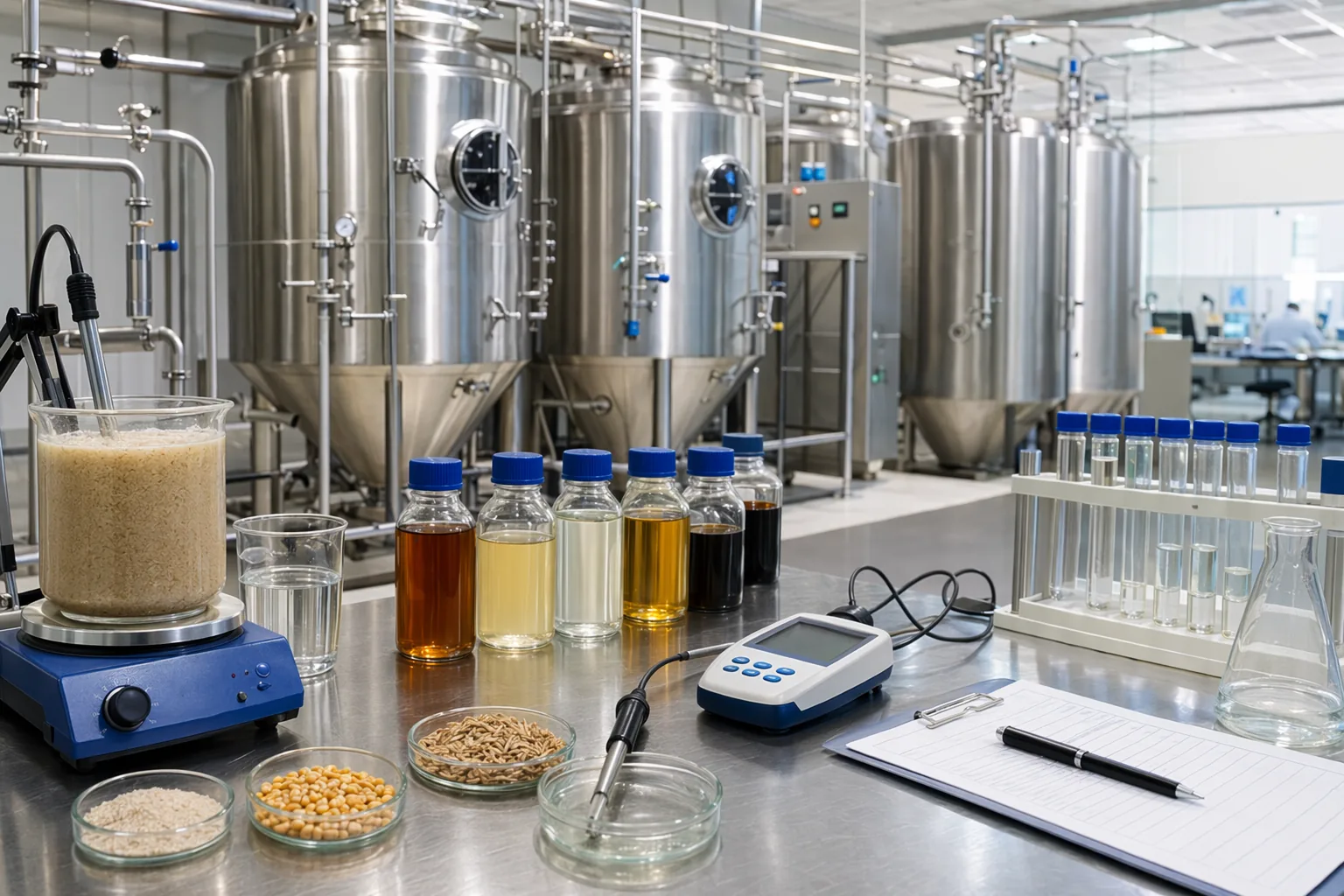
A practical B2B guide for comparing fungal acid protease options, validating process fit, and qualifying suppliers for ethanol and beverage alcohol production.
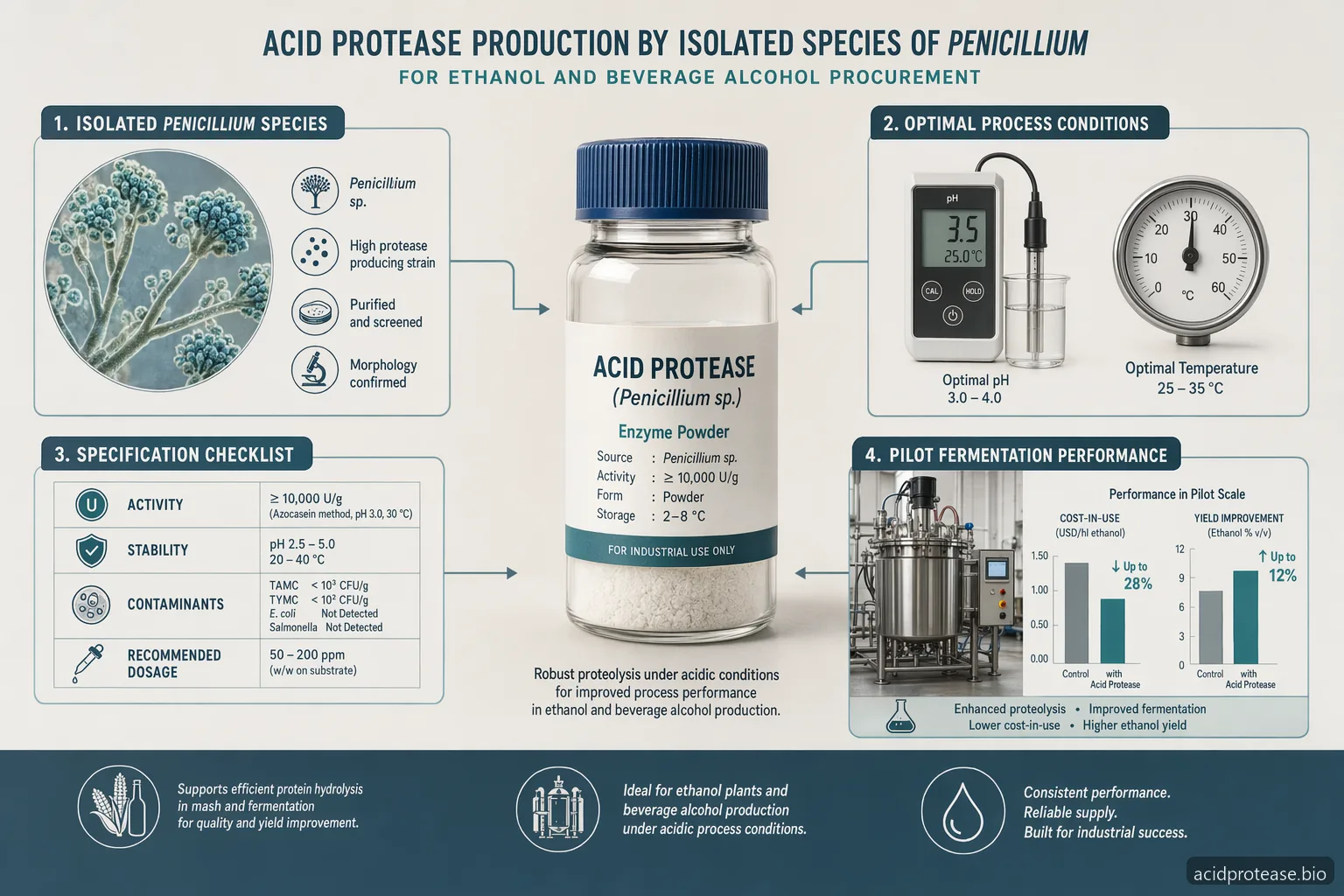
How Penicillium Options Compare With Other Fungal Acid Proteases
Research on acid protease production by isolated species of Penicillium is useful because Penicillium strains can express proteases that operate under acidic mash conditions. For an industrial buyer, however, strain origin is only the starting point. A commercial acid protease enzyme must show batch-to-batch consistency, defined activity, clean documentation, and measurable benefit in the plant. Buyers often compare Penicillium-derived candidates with fungal acid protease from Aspergillus systems, including literature on the process kinetics of acid protease production by Aspergillus niger. The practical question is not which organism sounds more attractive, but which product performs at your mash pH, temperature profile, retention time, substrate mix, and sanitation regime. In alcohol production, acid protease should help convert grain or protein-rich feedstock proteins into soluble peptides and amino nitrogen that support fermentation without creating off-spec residues or handling issues.
Compare performance at real mash pH, not only laboratory optimum pH. • Check activity units and assay conditions before comparing prices. • Evaluate strain-derived products through pilot fermentation, not desk review alone.
Process Conditions to Confirm Before Buying
Most industrial acid protease alcohol production trials start by matching the enzyme to the acidic stage where protein hydrolysis is useful. Typical screening ranges include pH 3.0 to 5.5 and temperatures from 40°C to 60°C, with many fungal acid proteases showing useful activity around pH 3.5 to 4.5. Exact conditions should follow the supplier TDS and your plant constraints. Dosage commonly needs activity-based optimization; initial trials may screen a broad band such as 50 to 300 grams per metric ton of grain or an equivalent activity-unit dose. For high-gravity mashes, viscous feedstocks, or protein-rich raw materials, higher or staged dosing may be evaluated. Hold time, shear, calcium level, sulfite exposure, and interactions with alpha-amylase, glucoamylase, phytase, or cellulase packages can change results. Always validate under your actual cook, saccharification, fermentation, and cleaning conditions.
Screen pH 3.0-5.5 when compatible with your process. • Screen 40-60°C unless the TDS specifies a narrower range. • Run activity-based dose response trials before commercial adoption. • Check compatibility with other enzyme and yeast inputs.
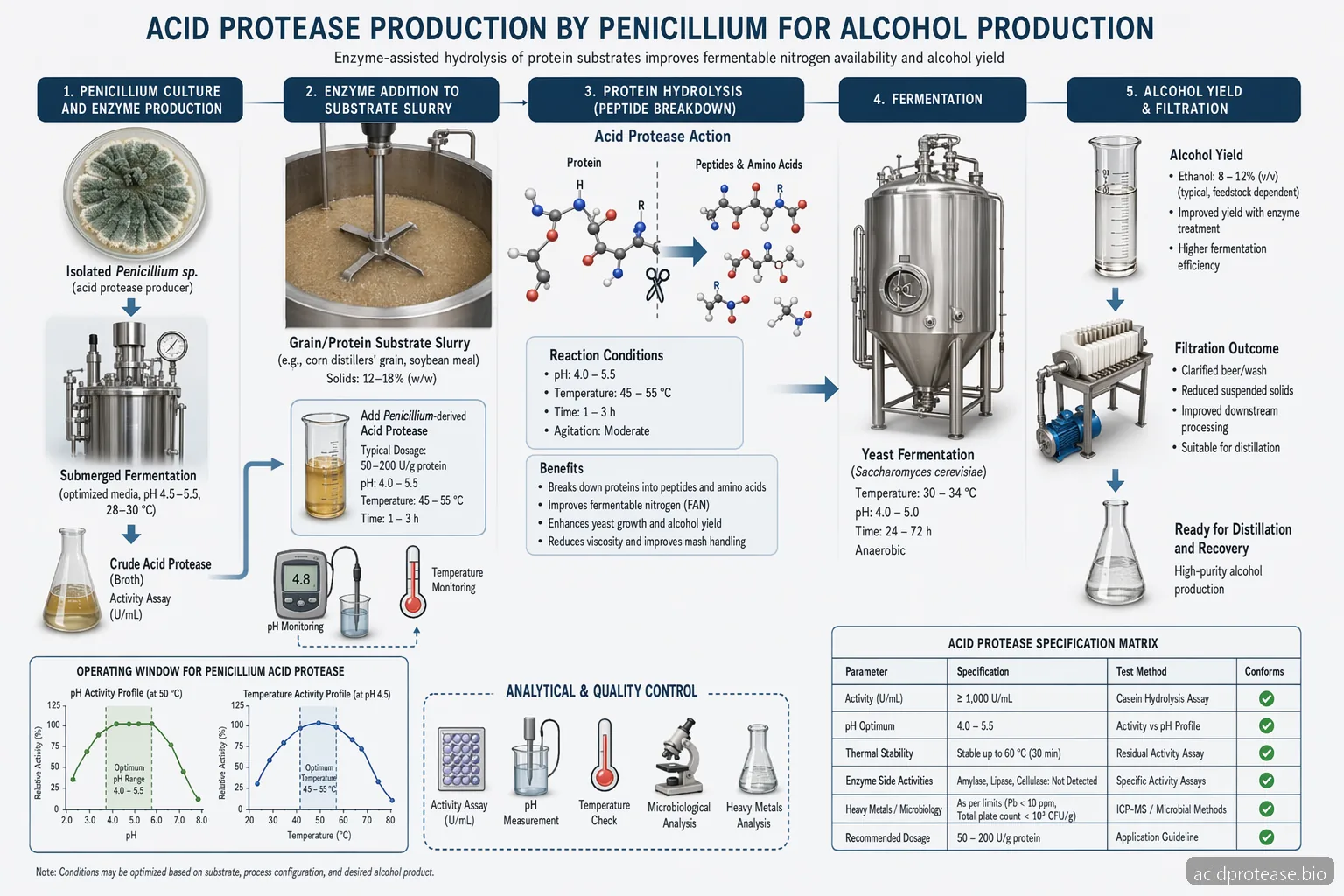
Specification Checklist for Alcohol Production Procurement
When sourcing an industrial acid protease enzyme alcohol production input, the procurement file should contain more than a price quote. Request a current COA for the lot, a technical data sheet with activity definition, an SDS, recommended use range, storage conditions, shelf-life statement, and packaging details. The COA should identify enzyme activity, appearance, moisture or carrier information when relevant, microbiological limits where applicable, and any declared processing aids or preservatives. A credible acid protease supplier for alcohol production should also explain the production organism type, whether the product is liquid or powder, and how activity is standardized. For imported or multi-site supply, ask how lots are released, how deviations are handled, and whether retained samples are available. These documents help QA, regulatory, and production teams decide whether a pilot trial can proceed without avoidable risk.
COA: lot-specific activity and release checks. • TDS: application guidance, dosage, pH, temperature, storage. • SDS: handling, PPE, spill, and inhalation precautions. • Supplier questionnaire: traceability, change control, complaint process.
Pilot Validation and Cost-in-Use Comparison
A low enzyme price does not always mean a low cost-in-use. Pilot validation should compare the candidate acid protease against your current process or a no-protease control. Track soluble protein, free amino nitrogen, viscosity, fermentation kinetics, final alcohol concentration, residual sugar, yeast health indicators, foam behavior, and coproduct quality where relevant. In fuel ethanol, also review throughput, heat-hold flexibility, stillage handling, and downstream separation effects. In beverage alcohol, include sensory and compliance review before scale-up. For a fair comparison, hold feedstock, yeast, glucoamylase, temperature, pH, and fermentation time as constant as possible. Calculate cost-in-use from delivered price, active dose, dilution losses, labor, inventory life, and yield or throughput change. This approach helps distinguish a technically interesting acid protease production story from a supplier-ready product.
Use controls and replicated pilot runs where feasible. • Measure yield and process stability, not only protein hydrolysis. • Include logistics, shelf life, and dilution losses in cost-in-use. • Confirm scale-up behavior before long-term contracting.
Supplier Qualification for Fungal Acid Protease
Searches such as industrial acid protease supplier alcohol production, industrial acid protease alcohol production, or acid protease supplier supplier for alcohol production often return many similar claims. Qualification should separate technical capability from marketing language. Ask whether the supplier can support trial design, provide stable lead times, document lot traceability, and notify customers of material changes. If the supplier references acid protease production in fungal root endophytes or other research sources, ask how that relates to the commercial enzyme being offered. Research origin does not replace manufacturing controls. A preferred acid protease supplier should provide realistic dosage guidance, clear limitations, and responsive troubleshooting during pilot work. They should also support confidentiality, sample shipment, scale-up planning, and complaint investigation. The best partner is not simply the lowest quote, but the one that reduces production uncertainty.
Request technical support before and during plant trials. • Confirm lot traceability and change notification practices. • Ask for realistic constraints, not only best-case performance claims. • Choose supply reliability and documentation quality alongside price.
Technical Buying Checklist
Buyer Questions
Not automatically. Penicillium isolates may produce useful acid proteases, and Aspergillus systems are also widely studied for fungal enzyme production. The better choice depends on your mash pH, temperature, substrate, dosage response, documentation, and supply consistency. Compare products through pilot fermentation using the same feedstock and operating conditions, then calculate cost-in-use rather than relying on organism name alone.
Dosage must be based on enzyme activity and process response. As an initial industrial screening band, many plants evaluate about 50 to 300 grams per metric ton of grain, or an equivalent activity-unit dose recommended by the supplier. Optimize with a dose response study that measures fermentation rate, final alcohol, nitrogen release, viscosity, and downstream handling.
At minimum, request a lot-specific COA, technical data sheet, SDS, activity assay definition, recommended dosage range, storage conditions, shelf life, and packaging details. For supplier qualification, also ask about traceability, change notification, deviation handling, complaint response, retained samples, and technical support. Documentation quality is a key part of risk reduction for B2B enzyme procurement.
Use a control and at least two or three enzyme dose levels under realistic plant conditions. Keep feedstock, yeast, pH, temperature, solids, and fermentation time as consistent as possible. Measure soluble nitrogen, viscosity, fermentation kinetics, residual sugars, final alcohol, foam behavior, and any coproduct impacts. Review both technical results and cost-in-use before approving scale-up.
Related Search Themes
acid protease production, process kinetics of acid protease production by aspergillus niger, industrial acid protease supplier alcohol production, industrial acid protease enzyme alcohol production, industrial acid protease alcohol production, acid protease supplier supplier for alcohol production
Acid Protease for Research & Industry
Need Acid Protease for your lab or production process?
ISO 9001 certified · Food-grade & research-grade · Ships to 80+ countries
Frequently Asked Questions
Is Penicillium-derived acid protease better than Aspergillus-derived acid protease?
Not automatically. Penicillium isolates may produce useful acid proteases, and Aspergillus systems are also widely studied for fungal enzyme production. The better choice depends on your mash pH, temperature, substrate, dosage response, documentation, and supply consistency. Compare products through pilot fermentation using the same feedstock and operating conditions, then calculate cost-in-use rather than relying on organism name alone.
What dosage should an alcohol plant use for acid protease?
Dosage must be based on enzyme activity and process response. As an initial industrial screening band, many plants evaluate about 50 to 300 grams per metric ton of grain, or an equivalent activity-unit dose recommended by the supplier. Optimize with a dose response study that measures fermentation rate, final alcohol, nitrogen release, viscosity, and downstream handling.
Which documents should an acid protease supplier provide?
At minimum, request a lot-specific COA, technical data sheet, SDS, activity assay definition, recommended dosage range, storage conditions, shelf life, and packaging details. For supplier qualification, also ask about traceability, change notification, deviation handling, complaint response, retained samples, and technical support. Documentation quality is a key part of risk reduction for B2B enzyme procurement.
How should we run a pilot trial for industrial acid protease?
Use a control and at least two or three enzyme dose levels under realistic plant conditions. Keep feedstock, yeast, pH, temperature, solids, and fermentation time as consistent as possible. Measure soluble nitrogen, viscosity, fermentation kinetics, residual sugars, final alcohol, foam behavior, and any coproduct impacts. Review both technical results and cost-in-use before approving scale-up.
Related: Acid Protease for Acidic Processing Lines
Turn This Guide Into a Supplier Brief Request acid protease specifications, samples, and pilot-trial support for your alcohol production process. See our application page for Acid Protease for Acidic Processing Lines at /applications/acid-protease-acidic-processing/ for specs, MOQ, and a free 50 g sample.
Contact Us to Contributehello@mail.acidprotease.bio