Acid Proteases Ochratoxin A Wine: How to Use Acid Protease in Wine Formulations
B2B guide to acid protease use in wine: pH, dosage, OTA considerations, QC checks, COA/TDS/SDS review, and supplier qualification.
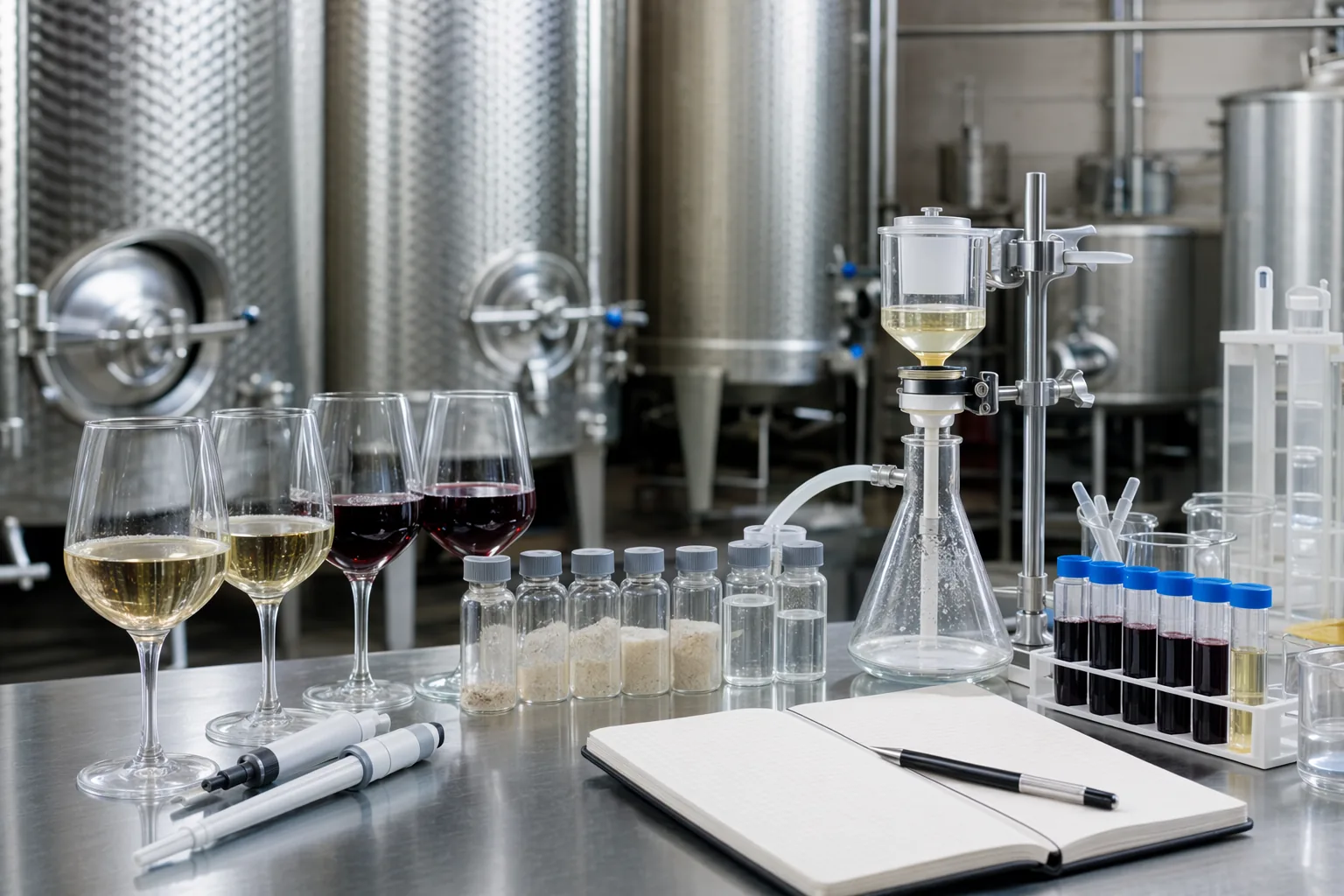
Acid protease can support wine protein management under low-pH conditions, but it should be validated carefully alongside ochratoxin A controls, filtration, and fining strategy.
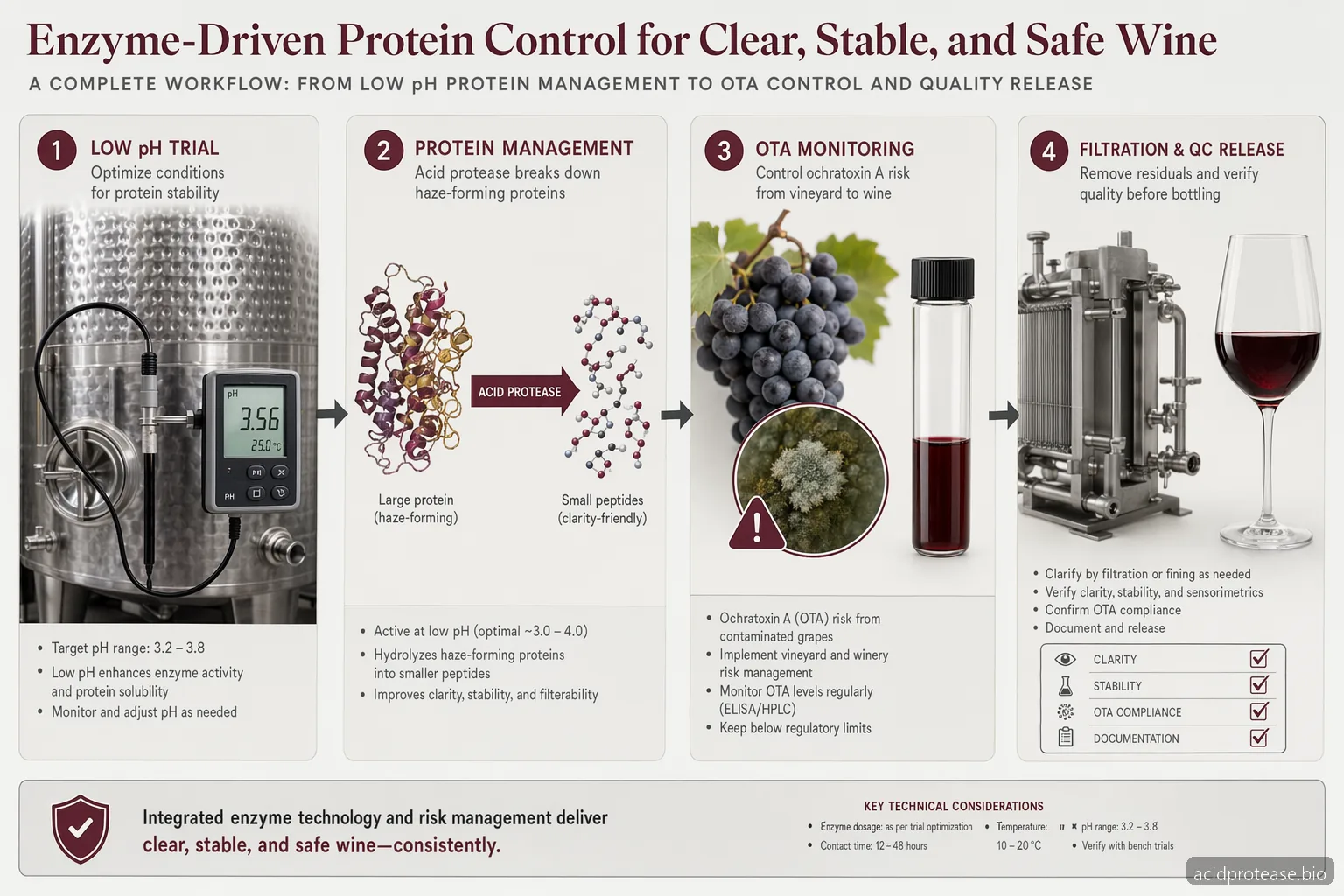
Where Acid Protease Fits in Wine Processing
For winery formulators, acid protease is an enzyme preparation designed to hydrolyze proteins under acidic conditions. In practical terms, that answers the question, what s meant acid proteases: they are proteolytic enzymes with useful activity in low-pH matrices such as must, wine, fruit bases, and some fermented beverages. Fungal acid protease is commonly evaluated because many fungal-derived preparations retain activity around wine pH, whereas neutral or alkaline proteases may be poorly matched. In wine, the target is usually protein modification: improving clarification, reducing haze-forming protein load, supporting yeast-derived peptide release, or lowering reliance on mineral fining after validation. The phrase acid proteases ochratoxin a wine should be handled carefully. Ochratoxin A is a regulated mycotoxin risk managed primarily through grape quality, sorting, adsorption, fining, and compliance testing. Acid protease may interact with the protein matrix, but it should not be specified as the primary OTA control unless validated with analytical data.
Use for protein hydrolysis and process optimization. • Do not position as a guaranteed OTA degradation step. • Validate in the exact varietal, pH, alcohol, and phenolic matrix.
Recommended Trial Conditions for Cellar Validation
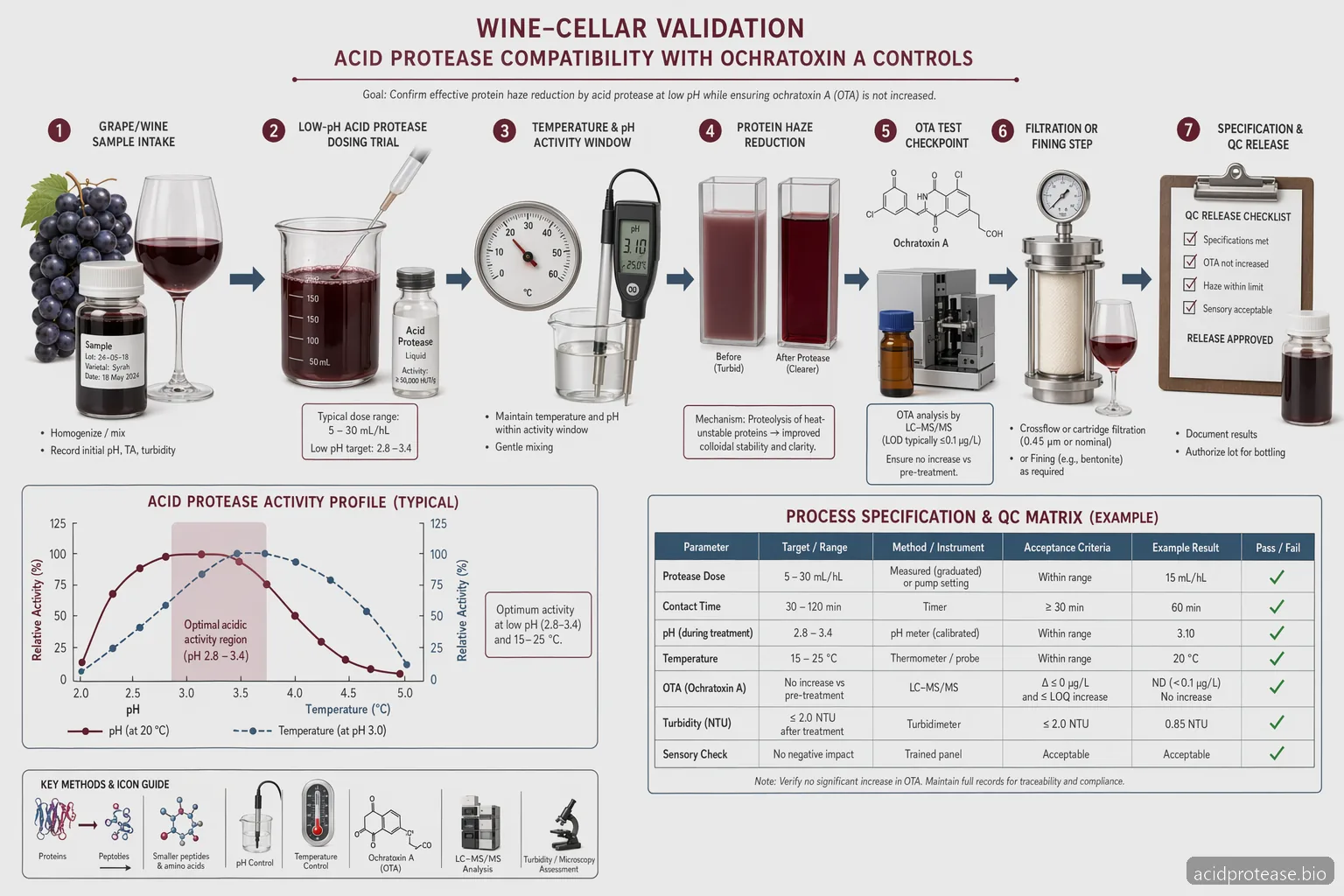
Start with bench trials before committing to plant-scale dosing. A practical screening design is pH 3.0-4.0, 10-20 °C for cellar-temperature treatment, and 35-50 °C only where the wine base, legal framework, and sensory objectives allow a warm holding step. Many acid protease enzyme preparations show stronger activity near pH 2.5-4.5 and 35-55 °C, but finished wine quality often limits the usable temperature. Dosage should be expressed by enzyme activity units, not only by grams. As a starting band, evaluate 10-100 mg/L for concentrated liquids or powders, or follow the supplier TDS and normalize by declared activity. Contact time may range from 2-24 hours at warmer conditions or 1-7 days at cellar temperature. Stop or remove enzyme according to the process design, typically by downstream fining, filtration, thermal handling where permitted, or natural dilution through racking.
Screen at low, medium, and high dose against an untreated control. • Track turbidity, filterability, protein stability, aroma, color, and mouthfeel. • Confirm residues and processing-aid rules for the target market.
Ochratoxin A Controls and Enzyme Compatibility
Ochratoxin A management in wine should be built as a risk-control system rather than a single additive decision. Begin with incoming grape assessment, mold pressure review, selective harvesting, sorting, and lot segregation. In-process controls may include clarification, yeast management, fining agents, adsorbents, activated carbon where appropriate, and validated filtration. Acid protease can be assessed for compatibility with these steps, especially if the formulation goal is to reduce proteinaceous haze or improve clarification before fining. However, OTA must be measured by suitable laboratory methods, such as HPLC or LC-MS/MS through an accredited laboratory or qualified internal method, depending on the business requirement. Do not infer OTA reduction from turbidity reduction. Enzyme suppliers should be asked whether their product contains carriers, preservatives, or side activities that may affect wine color, phenolics, sulfur dioxide management, or filtration aids. The acceptance criterion should be analytical evidence, sensory approval, and regulatory fit.
Measure OTA directly; do not use haze as a proxy. • Check compatibility with bentonite, carbon, chitosan, PVPP, and membrane filtration. • Run sensory triangle or descriptive checks after enzyme contact.
Specification, Documentation, and QC Checks
A qualified acid protease supplier should provide a current COA, TDS, and SDS for each commercial grade. The COA should list enzyme activity, appearance, lot number, manufacture or release date, recommended storage, and microbiological limits where applicable. The TDS should define activity assay conditions, optimal pH and temperature, application dosage, deactivation guidance, carrier composition, solubility, and handling recommendations. The SDS supports safe storage, spill response, and worker training. For wine applications, buyers should also request statements on heavy metals, relevant allergens or processing aids, GMO status where required by the market, and permitted-use documentation without relying on invented certifications. Incoming QC can include visual inspection, pH of solution, activity verification against a reference method, microbial checks for high-risk facilities, and small-scale performance in a standard wine substrate. Retain samples from each lot so complaints, dosage deviations, or seasonal performance shifts can be investigated.
Require lot-specific COA before release to production. • Keep retain samples and link enzyme lots to wine batches. • Verify storage conditions, especially temperature and moisture exposure.
Cost-in-Use and Supplier Qualification
The best acid protease enzyme is not always the lowest price per kilogram. Industrial buyers should calculate cost-in-use based on activity-normalized dose, contact time, yield improvement, filtration throughput, fining reduction, labor, tank occupancy, and any added QC testing. A concentrated fungal acid protease with consistent activity may cost more per unit mass but less per finished hectoliter if it reduces rework or improves filtration. Supplier qualification should include production capacity, batch consistency, lead time, packaging options, technical support, change-control notification, traceability, and complaint response. Ask for pilot support with statistically meaningful comparisons: untreated control, standard fining program, enzyme-assisted program, and enzyme plus OTA-control treatment if applicable. Commercial approval should require stable analytical results, acceptable sensory profile, predictable process performance, and documented regulatory review. For multi-site wineries, lock the specification by activity units and assay method so purchasing substitutions do not change the process.
Compare cost per treated hL, not just enzyme price. • Qualify a backup supplier only after matching activity and performance. • Document change control for formulation, carrier, or activity assay changes.
Technical Buying Checklist
Buyer Questions
Acid protease should not be specified as a stand-alone ochratoxin A removal technology. It hydrolyzes proteins and may change clarification behavior, but OTA control requires grape risk management, validated fining or adsorption where appropriate, and direct analytical testing. If a supplier claims OTA reduction, require controlled wine-matrix data, method details, detection limits, sensory results, and confirmation that the approach is permitted in your target market.
The phrase usually refers to exopeptidases, especially aminopeptidases and carboxypeptidases. Aminopeptidases release amino acids from the N-terminus of peptides, while carboxypeptidases release amino acids from the C-terminus. Many industrial acid protease products are mainly endoproteases, meaning they cut within protein chains. For wine formulation, ask the supplier for side-activity data if free amino nitrogen or flavor impact is a concern.
Lysosomal acid proteases are biological enzymes active in acidic cell compartments, and an example of acid proteases present in lysosome of neutrophil includes cathepsin-type proteases. They are useful scientific references but are not normally the commercial enzymes purchased for wine processing. Wineries typically evaluate food-processing enzyme preparations, often fungal acid protease, with documentation, defined activity, lot traceability, and application guidance.
Academic literature on the structure, function, and evolution of acid proteases can help technical teams understand catalytic mechanisms and enzyme families. However, purchasing specifications should be based on measurable commercial parameters: declared activity, assay conditions, pH-temperature profile, carrier system, impurities, microbiological limits, performance in wine, and supplier documentation. Literature is useful background, but pilot validation in your own wine matrix should drive approval.
Serine proteases and boronic acid small molecules are often discussed in biochemical inhibition research. Many acid proteases used industrially are aspartic proteases rather than serine proteases, so the relevance depends on the enzyme family. For wine, the practical issue is whether preservatives, fining agents, phenolics, sulfur dioxide, alcohol, or cleaning residues inhibit the selected enzyme under process conditions. Confirm this through supplier data and bench trials.
Proteases that cleave aspartic acid and proline describe substrate preference or cleavage specificity, not automatically application suitability. Wine proteins, grape pathogenesis-related proteins, yeast peptides, and colloids respond differently depending on pH, alcohol, phenolics, and temperature. If a supplier promotes a specific cleavage profile, request performance data in wine, not only purified protein assays. The deciding factors are stability improvement, sensory neutrality, filtration benefit, and compliance.
Related Search Themes
which two types of proteases produce a single amino acid, what s meant acid proteases, structure function and evolution of acid proteases hoffman, serine proteases boronic acid small molecules, proteases that cleave aspartic acid and proline, lysosomal acid proteases
Acid Protease for Research & Industry
Need Acid Protease for your lab or production process?
ISO 9001 certified · Food-grade & research-grade · Ships to 80+ countries
Frequently Asked Questions
Can acid protease remove ochratoxin A from wine?
Acid protease should not be specified as a stand-alone ochratoxin A removal technology. It hydrolyzes proteins and may change clarification behavior, but OTA control requires grape risk management, validated fining or adsorption where appropriate, and direct analytical testing. If a supplier claims OTA reduction, require controlled wine-matrix data, method details, detection limits, sensory results, and confirmation that the approach is permitted in your target market.
Which two types of proteases produce a single amino acid?
The phrase usually refers to exopeptidases, especially aminopeptidases and carboxypeptidases. Aminopeptidases release amino acids from the N-terminus of peptides, while carboxypeptidases release amino acids from the C-terminus. Many industrial acid protease products are mainly endoproteases, meaning they cut within protein chains. For wine formulation, ask the supplier for side-activity data if free amino nitrogen or flavor impact is a concern.
Are lysosomal acid proteases relevant to wine enzyme buying?
Lysosomal acid proteases are biological enzymes active in acidic cell compartments, and an example of acid proteases present in lysosome of neutrophil includes cathepsin-type proteases. They are useful scientific references but are not normally the commercial enzymes purchased for wine processing. Wineries typically evaluate food-processing enzyme preparations, often fungal acid protease, with documentation, defined activity, lot traceability, and application guidance.
Do academic terms like structure function and evolution of acid proteases hoffman affect specification?
Academic literature on the structure, function, and evolution of acid proteases can help technical teams understand catalytic mechanisms and enzyme families. However, purchasing specifications should be based on measurable commercial parameters: declared activity, assay conditions, pH-temperature profile, carrier system, impurities, microbiological limits, performance in wine, and supplier documentation. Literature is useful background, but pilot validation in your own wine matrix should drive approval.
How do serine proteases boronic acid small molecules relate to wine protease selection?
Serine proteases and boronic acid small molecules are often discussed in biochemical inhibition research. Many acid proteases used industrially are aspartic proteases rather than serine proteases, so the relevance depends on the enzyme family. For wine, the practical issue is whether preservatives, fining agents, phenolics, sulfur dioxide, alcohol, or cleaning residues inhibit the selected enzyme under process conditions. Confirm this through supplier data and bench trials.
Are proteases that cleave aspartic acid and proline useful in wine?
Proteases that cleave aspartic acid and proline describe substrate preference or cleavage specificity, not automatically application suitability. Wine proteins, grape pathogenesis-related proteins, yeast peptides, and colloids respond differently depending on pH, alcohol, phenolics, and temperature. If a supplier promotes a specific cleavage profile, request performance data in wine, not only purified protein assays. The deciding factors are stability improvement, sensory neutrality, filtration benefit, and compliance.
Related: Acid Protease for Acidic Processing Lines
Turn This Guide Into a Supplier Brief Request acid protease samples, COA/TDS/SDS, and pilot support for your wine formulation trials. See our application page for Acid Protease for Acidic Processing Lines at /applications/acid-protease-acidic-processing/ for specs, MOQ, and a free 50 g sample.
Contact Us to Contributehello@mail.acidprotease.bio