Commercial Acid Protease for Wine: Dosage, pH, and Temperature Troubleshooting
Troubleshoot acid protease use in wine: dosage bands, pH, temperature, QC, COA/TDS/SDS review, pilot trials, and supplier qualification.
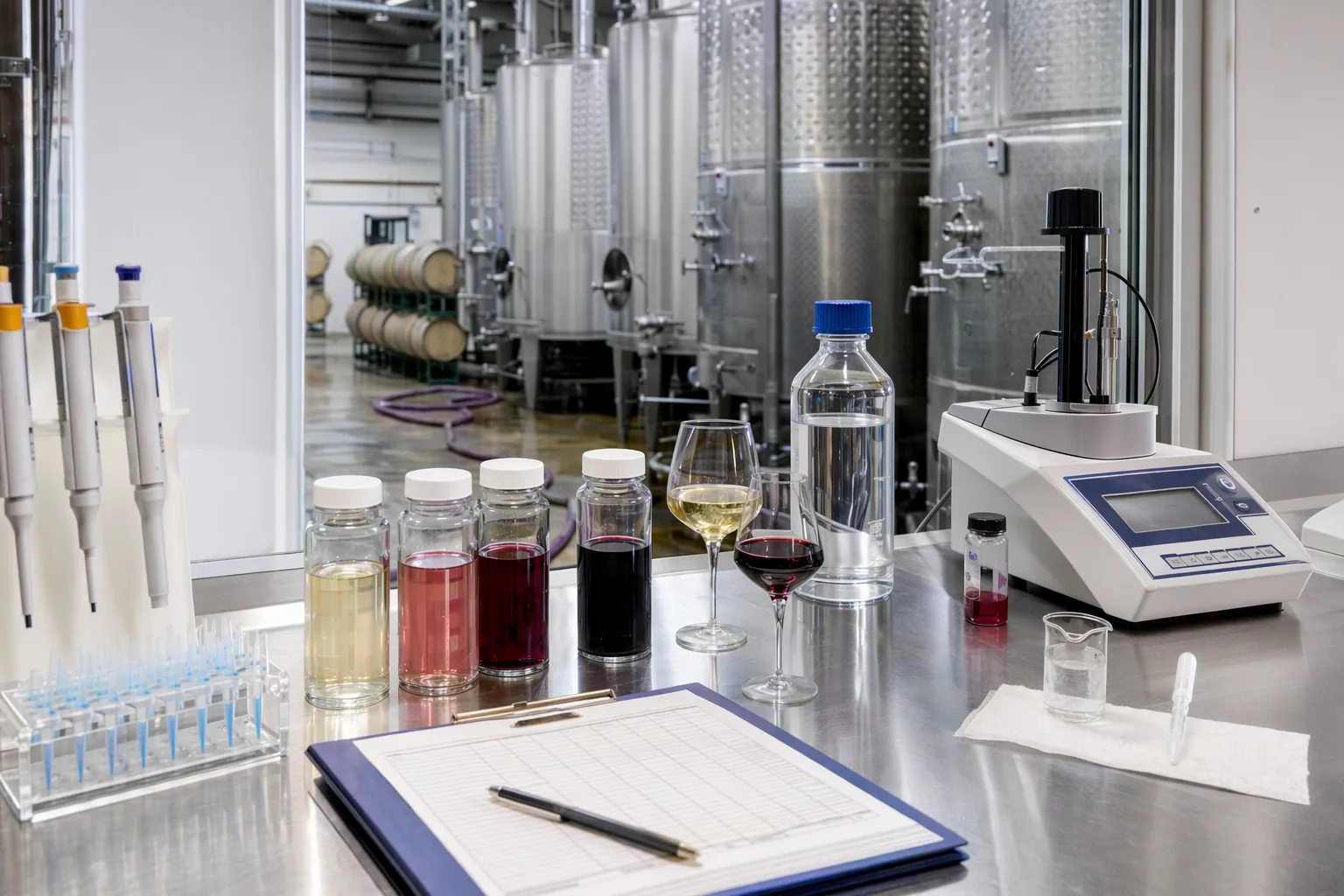
For wineries and ingredient buyers, acid protease selection is not only about activity units. Performance depends on wine pH, alcohol, temperature, contact time, compatibility, and supplier documentation.
Why acid protease is used in wine troubleshooting
Commercial acid protease wine trials are typically considered when a winery wants to improve protein management, clarification behavior, or downstream filtration without relying only on fining adjustments. Acid protease is a protease acid enzyme designed to hydrolyze susceptible proteins and peptides under acidic conditions. In wine, this matters because finished and fermenting wines often sit near pH 3.0-4.0, where neutral proteases may show limited activity. A fungal acid protease or other acid stable protease may help reduce problematic protein fractions, but results depend heavily on grape variety, heat load, phenolic matrix, alcohol, SO2, and contact time. Buyers should treat the enzyme as a process aid requiring validation, not as a universal fix. A good trial compares untreated control, current cellar practice, and multiple enzyme dosages under identical temperature and mixing conditions.
Useful for bench trials on haze risk and filtration resistance • Most relevant where wine pH is naturally acidic • Should be evaluated against sensory and stability targets
Dosage bands for pilot validation
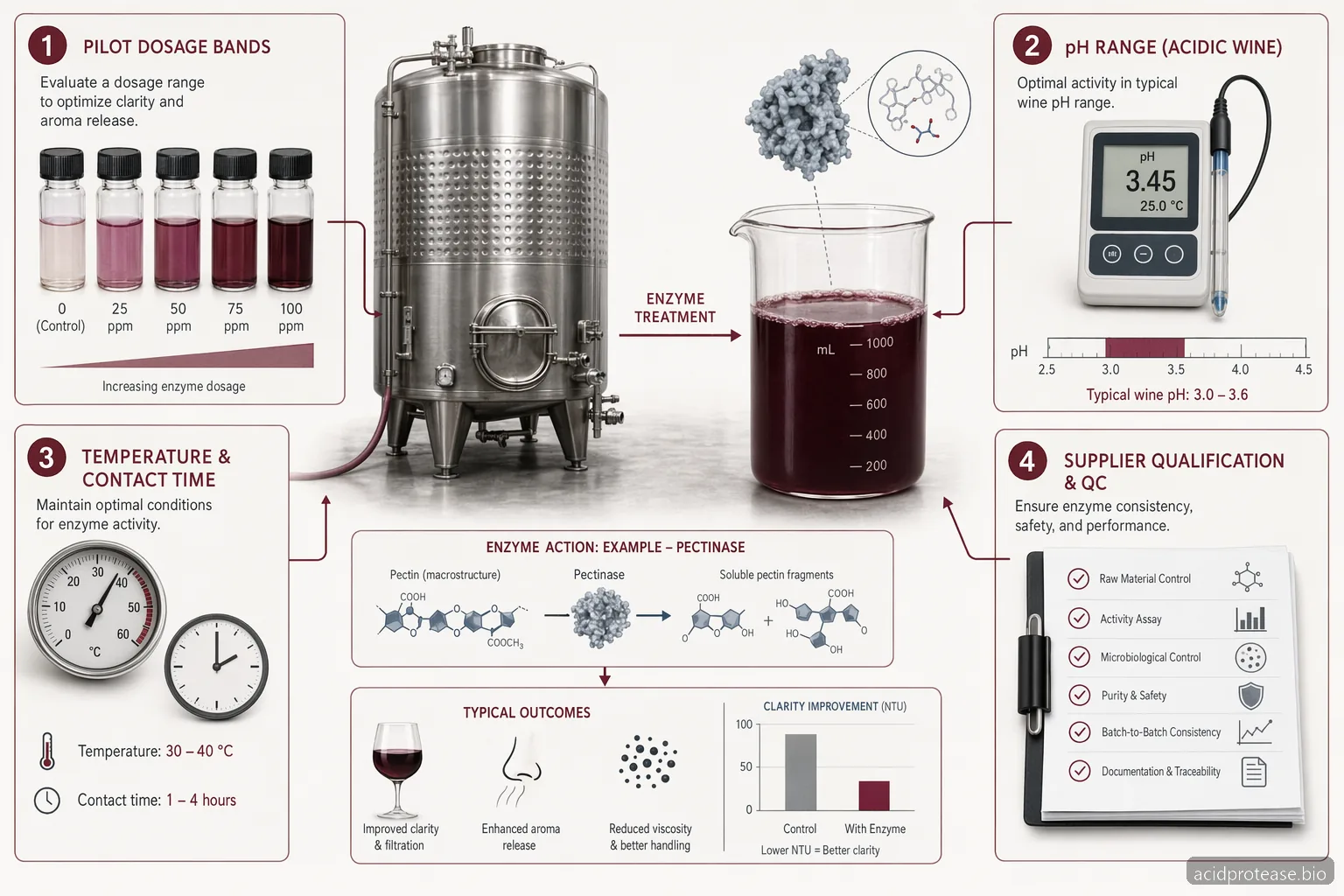
There is no universal acid protease dosage because commercial products differ in activity units, carrier, concentration, and formulation. As a starting point, wineries often screen low, medium, and high rates within the supplier TDS range, such as 5-50 g/hL for some dry preparations or 5-100 mL/hL for some liquid preparations. These are not specifications; they are practical pilot bands that must be adjusted to the stated activity and the target wine. Overdosing can increase cost-in-use and may create unnecessary peptide release or sensory risk, while underdosing may show no measurable benefit. For procurement, calculate dosage by enzyme activity delivered per hL, not only by product weight or volume. Keep a written trial plan with wine lot, pH, alcohol, temperature, SO2, contact time, addition point, mixing method, and analytical endpoints.
Run at least three rates plus an untreated control • Normalize comparisons by declared activity units where possible • Confirm whether dosage is based on juice, must, or finished wine volume
pH, temperature, and contact time controls
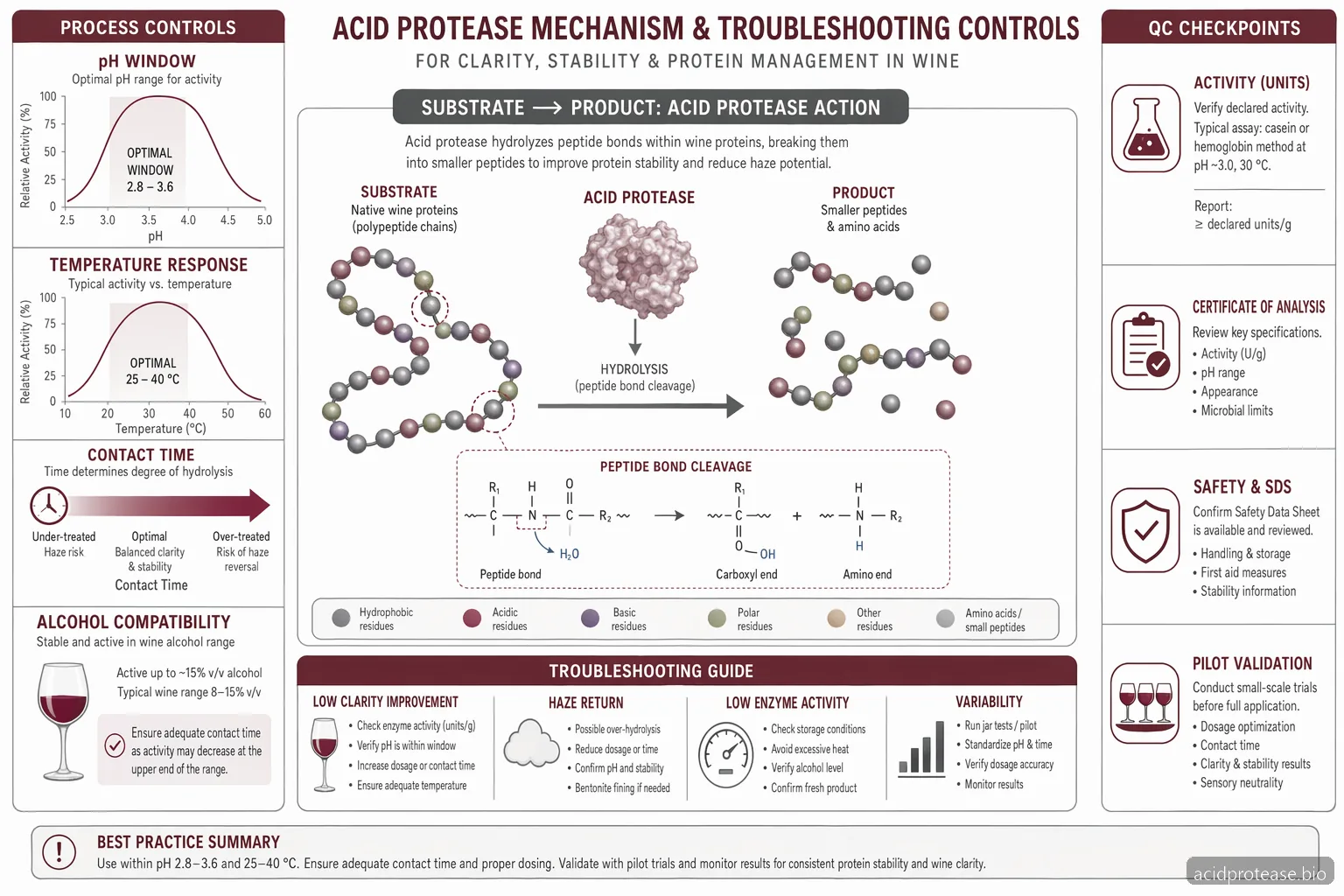
The best acid protease enzyme for wine is usually one that maintains useful activity at wine pH and cellar temperature. Many acid proteases show optimal activity around pH 2.5-4.5, but each product can differ, so the TDS should define the recommended pH range. Typical wine processing temperatures of 10-25°C may slow hydrolysis, while warmer trials around 30-45°C can accelerate reactions if the wine style, oxygen control, microbial risk, and sensory profile allow it. Some acid stable protease products tolerate higher short-term temperatures, but heat exposure must be validated carefully because wine aroma and color can be affected. Contact time can range from hours to days depending on dosage and temperature. Troubleshooting should separate enzyme failure from process limitations: low temperature, short contact, poor mixing, high alcohol, or incompatible fining agents can all reduce apparent performance.
Record actual tank temperature, not only room temperature • Avoid assuming laboratory optimum temperature is appropriate for wine • Check enzyme inactivation or removal strategy if required by your process
Mechanism and enzyme type: what buyers should know
Many commercial acid proteases used in acidic food processes are aspartic acid protease enzymes. The aspartic acid protease mechanism generally involves two catalytic aspartate residues that activate water and help cleave peptide bonds under acidic conditions. This explains why an acid protease can remain useful where alkaline or neutral proteases perform poorly. However, enzyme class alone does not guarantee wine performance. A procurement dossier should focus on declared activity method, substrate used for assay, pH profile, temperature profile, alcohol tolerance, formulation stability, and impurities relevant to beverage use. Search terms such as tev protease amino acid sequence or protease amino acid may appear in research contexts, but TEV protease is a different tool enzyme and not a practical benchmark for commercial wine trials. For wine buying decisions, prioritize application data and batch documentation over sequence curiosity.
Ask whether the product is fungal acid protease or another source • Compare assay conditions before comparing activity numbers • Do not substitute research protease data for wine application data
QC checks, documentation, and supplier qualification
A reliable acid protease supplier should support both technical validation and purchasing control. Before ordering production quantities, request a current COA for the batch, TDS for use conditions, SDS for safe handling, storage guidance, shelf-life statement, and any applicable food-use or allergen declarations. The COA should list activity, lot number, manufacturing or release date, and relevant microbiological or composition data when available. During trials, QC should measure turbidity, heat stability, filterability, soluble nitrogen or FAN where relevant, pH, alcohol, free and total SO2, and sensory impact after treatment. Evaluate cost-in-use by calculating enzyme cost per hL at the effective dosage, plus any savings in filtration, fining, tank time, or rework. Supplier qualification should also review lead time, packaging sizes, technical support, change notification practice, and consistency across lots.
Keep retained samples of trial lots and enzyme batches • Use the same QC method before and after treatment • Approve suppliers on performance, documentation, and continuity of supply
Technical Buying Checklist
Buyer Questions
An acid stable protease is a protease that retains useful activity under acidic conditions, often around the pH found in wine. In practice, this means the enzyme can hydrolyze selected proteins or peptides where neutral proteases may be inefficient. Buyers should still verify performance in the actual wine matrix because alcohol, SO2, phenolics, temperature, and contact time can change the result.
Start with the supplier TDS and create a small trial matrix with an untreated control and at least three dosage levels. Keep pH, temperature, mixing, contact time, and sample volume consistent. Measure turbidity, heat stability, filtration behavior, and sensory impact. Do not scale up from a single beaker result; repeat the best condition in a pilot tank or representative cellar trial.
Acid protease should not be assumed to replace bentonite without validation. It may reduce some protein-related issues, but wine haze stability depends on grape proteins, phenolics, pH, alcohol, and processing history. Many wineries evaluate enzyme treatment as part of a broader stability program. Compare enzyme-only, bentonite-only, and combined approaches to determine the lowest-risk, lowest-cost process.
For B2B purchasing, request a COA for the supplied lot, a TDS with dosage and operating conditions, an SDS, storage and shelf-life guidance, allergen and food-use statements, and traceability information. The COA should identify lot number and activity data. For recurring supply, ask how the supplier manages specification changes, batch variation, lead time, and technical support.
Common causes include low cellar temperature, short contact time, insufficient dosage, poor mixing, enzyme activity outside the wine pH range, high alcohol inhibition, or interference from fining agents. The wine may also contain proteins that are not readily hydrolyzed by that enzyme. Repeat the trial with confirmed enzyme activity, controlled temperature, longer contact time, and a clear analytical endpoint.
Acid Protease for Research & Industry
Need Acid Protease for your lab or production process?
ISO 9001 certified · Food-grade & research-grade · Ships to 80+ countries
Frequently Asked Questions
What is acid stable protease in wine processing?
An acid stable protease is a protease that retains useful activity under acidic conditions, often around the pH found in wine. In practice, this means the enzyme can hydrolyze selected proteins or peptides where neutral proteases may be inefficient. Buyers should still verify performance in the actual wine matrix because alcohol, SO2, phenolics, temperature, and contact time can change the result.
How should a winery set the first acid protease dosage trial?
Start with the supplier TDS and create a small trial matrix with an untreated control and at least three dosage levels. Keep pH, temperature, mixing, contact time, and sample volume consistent. Measure turbidity, heat stability, filtration behavior, and sensory impact. Do not scale up from a single beaker result; repeat the best condition in a pilot tank or representative cellar trial.
Can acid protease replace bentonite in wine?
Acid protease should not be assumed to replace bentonite without validation. It may reduce some protein-related issues, but wine haze stability depends on grape proteins, phenolics, pH, alcohol, and processing history. Many wineries evaluate enzyme treatment as part of a broader stability program. Compare enzyme-only, bentonite-only, and combined approaches to determine the lowest-risk, lowest-cost process.
What documents should an acid protease supplier provide?
For B2B purchasing, request a COA for the supplied lot, a TDS with dosage and operating conditions, an SDS, storage and shelf-life guidance, allergen and food-use statements, and traceability information. The COA should identify lot number and activity data. For recurring supply, ask how the supplier manages specification changes, batch variation, lead time, and technical support.
Why did acid protease show little effect in our wine trial?
Common causes include low cellar temperature, short contact time, insufficient dosage, poor mixing, enzyme activity outside the wine pH range, high alcohol inhibition, or interference from fining agents. The wine may also contain proteins that are not readily hydrolyzed by that enzyme. Repeat the trial with confirmed enzyme activity, controlled temperature, longer contact time, and a clear analytical endpoint.
Related: Acid Protease for Acidic Processing Lines
Turn This Guide Into a Supplier Brief Request acid protease COA, TDS, SDS, and a pilot-trial dosage recommendation for your wine process. See our application page for Acid Protease for Acidic Processing Lines at /applications/acid-protease-acidic-processing/ for specs, MOQ, and a free 50 g sample.
Contact Us to Contributehello@mail.acidprotease.bio